Key takeaways
- WWW DigitalNewsAlerts Com is not a news alert service — it is an affiliate content blog with no notification system of any kind.
- At least four separate domain variants exist under similar names, each with different content, ownership, and trust levels.
- Google Alerts, Feedly, and Apple News all deliver genuine keyword-based alerts — free, customizable, and functional within minutes of setup.
- A WHOIS lookup, VirusTotal scan, and a “[site name] + scam” search are the three fastest ways to assess any unfamiliar domain.
When users search for WWW DigitalNewsAlerts Com, they expect to land on a working news alert service — one that sends real-time notifications, lets them filter by topic, and keeps them ahead of breaking stories. What they actually find is something very different. This review breaks down exactly what the site is, who runs it, what the red flags are, and which legitimate services actually do the job.
What WWW DigitalNewsAlerts Com Actually Is
The name implies a news alert service. The reality is an affiliate content blog — a site that publishes sporadic articles across loosely related topics, monetized through affiliate partnerships rather than built around any notification functionality.
The non-hyphenated version, digitalnewsalerts.com, is the most active of the domain variants. Its content categories span tech, gaming, gadgets, and business, but a disproportionate volume of posts cover casino and gambling topics. That content mix is a strong signal: publishers building genuine news tools don’t need to pad revenue with gambling affiliate programs.
As reported by Fortune, research has found an inverse relationship between affiliate marketing use and content complexity — sites that rely heavily on affiliate links tend to produce lower-quality, less substantive material. Sites that do are usually optimizing for commission payouts, not reader value.
There is no alert system on the site. No email subscription tied to keywords. No push notification setup. No real-time feed. The name is the pitch — the product behind it does not exist.
How Many Domain Variants Exist — and Why That Matters
Searching for WWW DigitalNewsAlerts Com surfaces at least four distinct domain properties operating under similar names:
digitalnewsalerts.com — The most active variant. An affiliate blog with sporadic publishing across tech and gambling content. No editorial masthead, no named ownership.
www-digitalnewsalerts.com — A hyphenated variant with near-empty pages and no discernible content operation. Likely a parked or speculative domain registered to prevent competitors from owning it.
digitalnewsalerts.org — Presents as a general news blog with category menus across politics, sports, entertainment, and lifestyle. More structured in appearance but still no alert functionality.
digital-newsalerts.com — Minimal content, vague business description, no clear editorial purpose.
The proliferation of near-identical domain names around a single brandable phrase is a textbook pattern in low-quality site networks. Each property creates confusion, captures search traffic under slightly different queries, and funnels users toward affiliate content they didn’t intend to find. None of the four domains operates as an actual news alert service.
The Gap Between the Name and the Product
The phrase “digital news alerts” describes something specific and functional. Users who type it into a search bar are almost certainly looking for one of the following:
- A service that monitors the web for a keyword or phrase and emails them when new content appears
- A mobile app that pushes notifications from their preferred publications
- A dashboard where they can track topics across multiple sources simultaneously
Every major news alert service — Google Alerts, Feedly, Apple News — delivers some version of this. The domains operating under the DigitalNewsAlerts name deliver none of it. That gap between expectation and delivery is what makes the naming misleading, regardless of whether any individual domain is technically a “scam.”
The non-hyphenated site is not a security threat. Visiting it is unlikely to result in malware or a phishing attempt. But it will not do what users expect it to do, and the content they encounter there — casino roundups and surface-level tech posts — is not what they came for.
How to Check Any Unfamiliar Domain Before Trusting It
The DigitalNewsAlerts situation is a useful template for evaluating unfamiliar websites in general. A site can be perfectly safe to browse while still being entirely useless, misleading, or misrepresenting its purpose. Here is a reliable four-step process that takes under three minutes.
Step 1: Check for HTTPS. The padlock icon in the browser address bar confirms the connection is encrypted. Its absence is a hard red flag on any site asking for personal information. Its presence, however, does not confirm the site is legitimate — only that the connection is secure.
Step 2: Look for a real About page and named ownership. Credible sites name their editorial team, explain their purpose, and provide a physical or organizational address. Vague “About us” language with no names and no verifiable organization behind it is a consistent feature of low-quality content operations.
Step 3: Run the URL through a security scanner. VirusTotal aggregates results from dozens of antivirus engines to flag malware, phishing, and other active threats. Paste the domain, check the output, and look for red flags before submitting any personal data.
Step 4: Search “[site name] + scam” or “[site name] + reviews.” If a site has a history of misleading users, complaints almost always surface through this query. It takes thirty seconds and is often the fastest signal available.
Applying all four steps to digitalnewsalerts.com produces a consistent picture: no active threat, no credible editorial operation, no functional product.
What a Real News Alert Service Looks Like
For users who came to WWW DigitalNewsAlerts Com hoping to set up genuine news monitoring, here are the services that actually deliver it.
Google Alerts
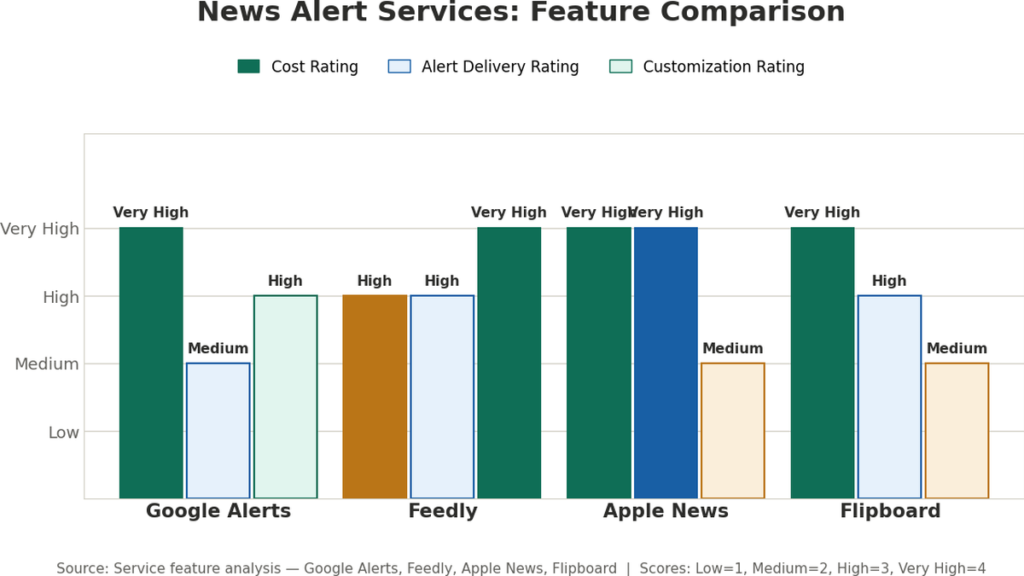
Google Alerts is the simplest and most widely used option. Users enter a keyword or phrase, choose how often they want updates — as they happen, once a day, or once a week — and receive email digests whenever Google indexes new content matching that term. Setup takes under sixty seconds. It is completely free and requires only a Google account.
The main limitation is delivery format: Google Alerts sends email only. It does not push notifications to mobile devices, and it does not offer an in-app reading experience. For users who want topic monitoring tied to a specific inbox, it is hard to beat.
Feedly
Feedly operates on an RSS-based model. Users subscribe directly to publications, blogs, or keyword feeds, and all new content from those sources appears in a centralized dashboard. Unlike algorithmic aggregators, Feedly shows everything from subscribed sources — nothing is filtered out by an engagement algorithm. As reported by TechCrunch, Feedly has continued to evolve into a knowledge management platform, adding collaborative boards, annotations, and tools that go well beyond basic feed reading.
Free accounts support a limited number of feeds and sources. Paid tiers add AI-powered filtering, team collaboration tools, and deeper integrations with tools like Slack and Zapier. For users who want control over exactly what they read and where it comes from, Feedly is the strongest option in this category.
Apple News
Apple News is built into every iPhone and Mac. Users follow publications and topics, and the app learns from reading behavior to surface relevant content. Push notifications are available for breaking stories. The trade-off is reduced control — Apple’s algorithm makes curation decisions the user cannot fully override — but for casual news consumers who want mobile-first delivery without any configuration overhead, it is the lowest-friction option available.
Flipboard offers a visually oriented magazine-style interface and is available across iOS, Android, and web. It supports topic following, source subscriptions, and community-curated “magazines” assembled by other users. It sits between Apple News and Feedly in terms of customization — more control than a pure algorithmic feed, less than a full RSS reader.
Side-by-Side Comparison
Final Assessment of WWW DigitalNewsAlerts Com
WWW DigitalNewsAlerts Com is not what its name implies. Across all four domain variants, there is no alert functionality, no editorial identity, no notification system, and no news monitoring capability. The non-hyphenated site is an affiliate blog with a misleading name. The hyphenated and alternative variants offer even less.
Users searching for a real news alert service should go directly to Google Alerts for free keyword-based email monitoring, Feedly for RSS-driven source control, or Apple News for push notifications on a mobile device. All three are free to start, verifiable, and actually do what the name “digital news alerts” suggests.
Frequently Asked Questions
Is WWW DigitalNewsAlerts Com a legitimate website?
It is a real website — it loads and does not pose an active malware threat. But it is not a legitimate news alert service. It operates as an affiliate content blog with no notification functionality, no editorial standards, and no named ownership.
Why does searching for WWW DigitalNewsAlerts Com return multiple different sites?
Several domain variants — digitalnewsalerts.com, www-digitalnewsalerts.com, digitalnewsalerts.org, and digital-newsalerts.com — have been registered around the same phrase by different owners. This is a common pattern with brandable domain names and creates deliberate confusion among users searching for a specific service.
Can I actually receive news alerts from digitalnewsalerts.com?
No. The site does not offer email subscriptions tied to keywords, push notifications, or any other alert mechanism. It publishes static blog posts. For actual news alerts, use Google Alerts, Feedly, or Apple News.
Are any of the DigitalNewsAlerts domain variants worth using?
None of them deliver the functionality users searching for a news alert service are looking for. For content browsing, the non-hyphenated site has occasional tech and gaming articles, but the quality is surface-level and the gambling content is disproportionate. There are no reasons to use any of these domains when better-built, fully functional alternatives exist.