Key takeaways
- Mailchimp reached a $12 billion exit after growing for years without a single dollar of venture capital.
- SaaS founders raising at $15K MRR typically negotiate 30–50% higher valuations than pre-revenue peers raising the same amount.
- SBIR and STTR grants offer up to $2M in non-dilutive federal funding before you touch your cap table.
- Most B2B SaaS founders underprice their first customer cohort by 30–50%, destroying the margin needed to reinvest.
A startup booted fundraising strategy is a founder-led model that prioritizes revenue generation before — or instead of — seeking outside capital. It combines bootstrapping discipline with selective, milestone-gated funding rounds to preserve founder control, minimize equity dilution, and approach investors from a position of demonstrated traction rather than desperation.
What Is a Startup Booted Fundraising Strategy?
The core idea is simple: build proof first, then raise on your terms. Instead of going to investors with a deck and a dream, founders using this approach build revenue, prove the model, and only open fundraising conversations when milestones make the terms favorable to them.
“Booted” does not mean ejected from a company. In founder circles, it is shorthand for bootstrapped-to-funded — a hybrid path that starts with self-funding discipline and ends with selective external capital. You boot up your business like a computer boots its operating system: self-sufficient first, external dependencies only when the system is stable.
Booted vs. Bootstrapped vs. VC-Backed
Pure bootstrapping means no outside capital — ever. A booted strategy is different. It accepts that external capital may be appropriate, but only after revenue validates the model. The distinction is timing and leverage, not ideology.
| Dimension | Bootstrapped | Startup Booted | VC-Backed |
| Capital Source | Revenue only | Revenue first, then selective raises | Investor capital from early stage |
| Equity Impact | Zero dilution | Minimal to moderate | Significant, often early |
| Founder Control | Full | High | Board seats, veto rights |
| Growth Speed | Slower | Moderate then accelerated | Fast, capital-driven |
| Best Fit | Services, niche SaaS | SaaS, B2B tools, marketplaces | Deep tech, biotech, hardware |
Is This Strategy Right for Your Business?
The booted approach works best for founders who can reach first revenue under $500K in capital, operate in markets with moderate competitive intensity, and build software or services with gross margins above 60%. It is a poor fit for deep tech, pharmaceutical, or hardware businesses where the product cannot exist without capital deployed long before a customer can pay.
Second-time founders with domain expertise, solo founders with low personal burn rates, and technical founders in high-margin software categories benefit most from this path.
How to Execute — Step by Step
Step 1 — Validate with revenue before building at scale. Find one person who will pay you before you build the full product. Pre-sales, pre-orders, and consulting engagements are all valid instruments. Build only what closes the sale.
Step 2 — Structure lean operations around reinvestable margin. Target gross margins above 60% for software, 40–50% for services. Below those thresholds, reinvestment capacity is structurally too thin for a booted approach without external capital.
Step 3 — Exhaust non-dilutive funding first. Revenue-based financing, government grants — including the SBIR and STTR programs which, according to America’s Seed Fund (SBIR.gov), provide non-dilutive equity-free funding through federal agencies to small businesses — customer prepayments, and equity-light accelerators can extend runway without changing your cap table.
Step 4 — Build your metrics stack from day one. Track MRR, CAC, churn rate, gross margin, and runway from your first paying customer. Investors will ask for 12–24 months of historical data.
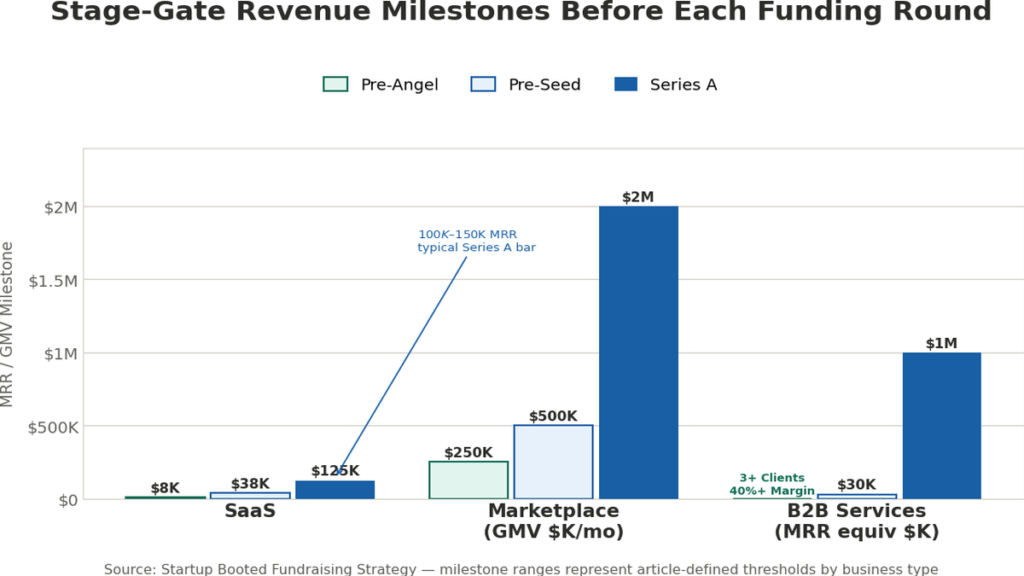
Step 5 — Set stage-gate milestones before opening any raise conversation.
Step 6 — Select investors strategically, not desperately. A booted strategy gives you optionality. Ask every investor about their follow-on strategy, portfolio companies similar to yours, and how they support founders during a growth plateau. Capital-only investors are not wrong — but they are different.
Step 7 — Build your fundraising narrative from your revenue story. Your pitch is a data story: what customers pay for and why, how you acquired them efficiently, what the retention curve looks like, and what additional capital unlocks that organic growth cannot.
Real-World Proof It Works
The strongest documented example is Mailchimp, which operated without outside venture capital from its founding through its $12 billion acquisition by Intuit in 2021, as reported by TechCrunch. Ben Chestnut and Dan Kurzius retained significant ownership at exit precisely because they never traded equity for early-stage capital. Zoho and Basecamp follow the same pattern: margin discipline early, revenue proven before scaling, and external capital treated as an accelerant rather than a foundation.
Common Mistakes to Avoid
Treating booted as a permanent anti-raise ideology. The strategy is a sequence, not a religion. Founders who refuse capital while competitors win distribution can fall behind permanently.
Under-pricing early customers. Most B2B SaaS founders report their first cohort was underpriced by 30–50%. Thin margins prevent reinvestment. Price at value from day one.
Waiting too long to raise as runway collapses. Set a six-month runway threshold at which fundraising conversations must begin regardless of milestone status.
Ignoring competitive capital dynamics. When a direct competitor raises $10M and doubles their sales team, monitor their deployment and reassess your milestone timeline accordingly.
Conclusion
A booted fundraising strategy is not a compromise — it is a deliberate sequencing of proof before capital. Founders who execute it well reach investor conversations with leverage most pre-revenue startups never have. Assess your sector fit honestly, set measurable milestones before any raise conversation, and treat external capital as an accelerant, not a foundation.
Frequently Asked Questions
What is a startup booted fundraising strategy?
A startup booted fundraising strategy is a hybrid funding model where founders prioritize generating revenue before seeking outside capital. Often called “bootstrapped-to-funded,” it means building proof of product-market fit first, then approaching investors from a position of traction and leverage — rather than pitching on potential alone. The goal is to preserve founder control and minimize equity dilution by raising only when milestones make the terms favorable.
How is a booted strategy different from bootstrapping?
Pure bootstrapping means never taking outside capital. A booted strategy is different — it accepts external funding, but only after revenue validates the business model. The distinction is about timing and leverage, not ideology. Bootstrapping is a permanent stance; booted is a deliberate sequence. Founders use early revenue to build negotiating power before opening any fundraising conversations.
What types of businesses are best suited for a booted fundraising approach?
The booted approach works best for SaaS products, B2B tools, and marketplaces where first revenue is achievable under $500K in capital and gross margins can exceed 60%. It is particularly well-suited for technical founders, second-time founders with domain expertise, and solo founders with low personal burn rates. It is a poor fit for deep tech, biotech, or hardware ventures where building the product requires substantial capital long before any customer can pay.
What milestones should a SaaS startup hit before raising a seed round?
For a SaaS business following a booted strategy, the recommended milestones are: $5K–$10K MRR before an angel round, $25K–$50K MRR before a pre-seed round, and $100K–$150K MRR before a Series A conversation. Beyond revenue, investors will also want to see 12–24 months of historical data on CAC, churn rate, gross margin, and runway — so tracking these metrics from the first paying customer is essential.
Are there real examples of companies that succeeded with a booted fundraising strategy?
Yes. Mailchimp is the most prominent example — it operated for years without venture capital before being acquired by Intuit for $12 billion in 2021, with founders retaining significant ownership at exit because they never traded equity for early-stage capital. Zoho and Basecamp followed similar paths: margin discipline early, revenue proven before scaling, and external capital treated as an accelerant rather than a foundation for the business.