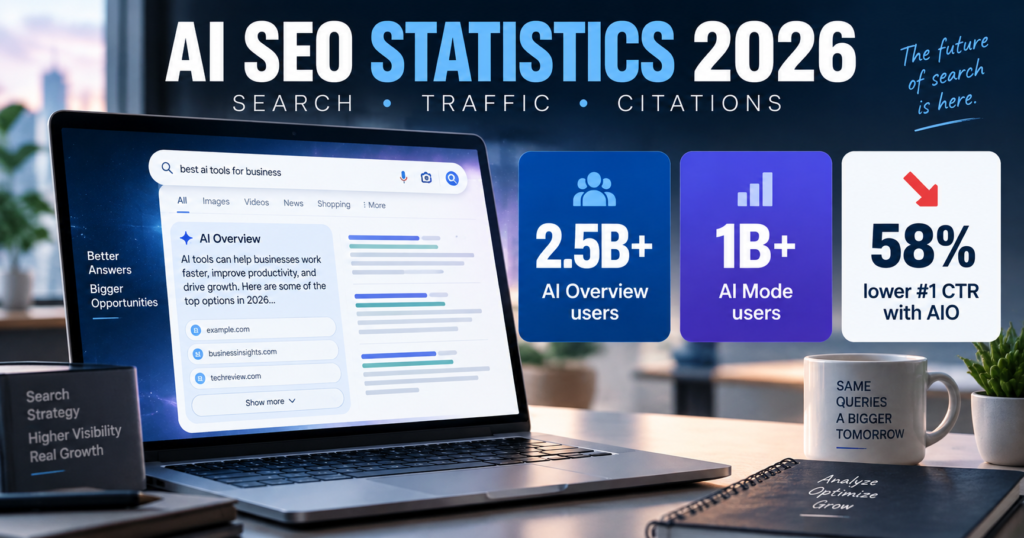
The clearest ai seo statistics signal in 2026 is scale: Google says AI Overviews now reach more than 2.5 billion monthly active users, while AI Mode has passed 1 billion monthly users. Those products now sit beside ChatGPT and other assistants as major discovery surfaces.
This roundup covers adoption, AI Overview exposure, click-through rates, referral traffic, citations, query patterns, and practical benchmarks using primary or near-primary research published in 2025 and 2026.
Quick answer: The latest ai seo statistics show AI search has reached mass adoption, but click behavior varies sharply: AI Overviews have 2.5B+ monthly users, while Ahrefs measured a 58% lower position-one CTR when an AI Overview appeared in late 2025 (Google, 2026; Ahrefs, 2026).
Key AI SEO statistics at a glance
- Google reported 2.5B+ monthly AI Overview users in 2026. (Google, 2026)
- AI Mode passed 1B monthly users in 2026. (Google, 2026)
- Ahrefs found a 58% lower average position-one CTR on SERPs with AI Overviews in its 2026 update. (Ahrefs, 2026)
- Similarweb measured 770.7M average monthly AI referral visits from June 2025 through May 2026, up 117.4% year over year. (Similarweb, 2026)
- Seer found that an AI Overview citation delivered 120% more organic clicks per impression than being present but not cited in its 2026 study. (Seer Interactive, 2026)
AI search adoption and usage statistics
AI search is now a mainstream behavior rather than a niche experiment. These ai seo statistics establish the audience size and show why SEO teams are measuring Google AI features and standalone assistants at the same time.
- In 2026, Google reported that AI Overviews had more than 2.5 billion monthly active users. (Google, 2026) For ai seo statistics benchmarking, this is the broadest disclosed Google AI search audience measure in the current source set.
- In 2026, Google said AI Mode had surpassed 1 billion monthly users. (Google, 2026) For ai seo statistics reporting, AI Mode should now be treated as a separate visibility surface from standard organic results.
- In 2026, Google made Search Live available in more than 200 countries and territories where AI Mode is offered. (Google, 2026) This ai seo statistics benchmark also shows that multimodal search is no longer limited to a small test market.
- In 2025, Google said AI Overviews had grown from more than 1 billion users in March to more than 1.5 billion monthly users by May. (Google, 2025; Google, 2025) The ai seo statistics trend shows how quickly Google expanded generative answers across its existing search audience.
- In 2025, Google reported that AI Overviews increased usage by more than 10% for the query types that showed them in the U.S. and India. (Google, 2025) This ai seo statistics signal matters because product usage can rise even when outbound clicks do not rise with it.
- In 2025, Google said early AI Mode queries were two to three times longer than traditional searches. (Google, 2025) For ai seo statistics analysis, longer conversational queries deserve their own keyword and prompt segment.
- In 2025, OpenAI said nearly 700 million people used ChatGPT each week, as reported by Reuters. (OpenAI, 2025) This ai seo statistics audience benchmark explains why ChatGPT visibility can matter even before referral traffic becomes large.
- In 2025, SparkToro and Datos found that more than 20% of Americans were heavy AI-tool users, defined as 10 or more uses per month. (SparkToro, 2025) The ai seo statistics takeaway is that frequent AI use already represents a material minority of U.S. users.
- In 2025, the same SparkToro and Datos analysis found that nearly 40% of Americans used an AI tool at least once per month. (SparkToro, 2025) This ai seo statistics adoption measure captures casual users as well as the smaller heavy-user segment.
- In 2025, SparkToro and Datos measured monthly AI-tool adoption rising from 8% to 38% across roughly two and a half years, a near-fivefold increase. (SparkToro, 2025) The ai seo statistics trend is rapid, but the same study found traditional search remained deeply embedded in user behavior.
AI search audience benchmarks
| Metric | 2025 level | 2026 level | Change or context |
| Google AI Overviews monthly users | 1.5B+ | 2.5B+ | At least 1B more users |
| Google AI Mode monthly users | 100M in U.S. and India | 1B+ globally | Tenfold scale versus the earlier disclosed base |
| ChatGPT weekly users | Nearly 700M | Not used as a 2026 level here | OpenAI disclosure from 2025 |
| U.S. heavy AI-tool users | 20%+ | Not re-measured in cited source | 10+ uses per month |
Source: Google 2025-2026, OpenAI 2025, SparkToro/Datos 2025.
For readers using ai seo statistics to set channel priorities, the main implication is reach. AI search now touches audiences measured in hundreds of millions or billions, so visibility tracking needs to cover more than classic blue-link rankings. Traditional search still matters, but the discovery path is wider. A practical reporting view is to keep Google organic, Google AI features, and standalone assistants in separate rows, then compare reach, clicks, and conversions without treating one channel as a direct substitute for another.
Google AI Overview prevalence and query triggers
Exposure is uneven by intent, query length, topic, and wording. The most useful ai seo statistics here are benchmarks that help teams estimate which parts of a keyword portfolio face the highest AI Overview exposure.
- In 2025, Ahrefs found AI Overviews on 20.5% of 146.1 million desktop SERPs in its September dataset. (Ahrefs, 2025) This ai seo statistics baseline is useful for estimating exposure across a broad desktop keyword portfolio.
- In 2025, Ahrefs found that 99.9% of keywords triggering AI Overviews had informational intent. (Ahrefs, 2025) The ai seo statistics pattern confirms that informational content carries the greatest AI Overview exposure in this dataset.
- In 2025, Ahrefs measured AI Overviews on 21.4% of informational queries, versus 4.3% of commercial queries. (Ahrefs, 2025) This ai seo statistics split makes intent classification a practical forecasting input for content teams.
- In 2025, Ahrefs measured AI Overviews on 2.1% of transactional queries and 0.9% of navigational queries. (Ahrefs, 2025) The ai seo statistics gap shows why navigational and transactional terms should not be modeled like informational terms.
- In 2025, Ahrefs found AI Overviews were 1.9 times more common for non-branded keywords than branded keywords. (Ahrefs, 2025) This ai seo statistics ratio also suggests brand demand can reduce, though not eliminate, AI Overview exposure.
- In 2025, Ahrefs measured AI Overviews on 24.9% of non-branded queries versus 13.1% of branded queries. (Ahrefs, 2025) The ai seo statistics difference gives teams a simple benchmark for branded versus discovery-query risk.
- In 2025, Ahrefs found that 46.4% of queries containing seven or more words triggered an AI Overview. (Ahrefs, 2025) This ai seo statistics benchmark supports separate reporting for long conversational queries and short head terms.
- In 2025, only 9.5% of single-word queries triggered an AI Overview in the Ahrefs dataset. (Ahrefs, 2025) The ai seo statistics contrast shows that query length can be a strong exposure signal before any page-level analysis.
- In 2025, Ahrefs measured AI Overviews on 57.9% of question queries versus 15.5% of non-question queries. (Ahrefs, 2025) This ai seo statistics result makes question-led content a priority segment for citation monitoring.
- In 2025, 44.1% of medical YMYL queries triggered an AI Overview in Ahrefs data, compared with 20.5% across the full dataset. (Ahrefs, 2025) The ai seo statistics result is especially relevant to publishers in health, finance, legal, and other YMYL categories.
AI Overview exposure by query type
| Query type | AI Overview rate | Dataset year | Benchmark use |
| Questions | 57.9% | 2025 | High-exposure informational content |
| 7+ word queries | 46.4% | 2025 | Long-tail content planning |
| Medical YMYL | 44.1% | 2025 | High-exposure regulated topics |
| Non-branded | 24.9% | 2025 | Discovery queries |
| Branded | 13.1% | 2025 | Brand demand |
| Navigational | 0.9% | 2025 | Low-exposure destination queries |
Source: Ahrefs 2025, 146.1 million desktop SERPs.
These ai seo statistics suggest that AI Overview risk is concentrated rather than uniform. Question-led, long, informational, and medical queries sit well above the overall baseline, while navigational intent remains far less exposed. Keyword segmentation is therefore more useful than one sitewide AI-exposure assumption. Teams can group tracked terms by intent and query form, calculate the share that triggers an AI answer, and then focus citation work on clusters where exposure is both frequent and commercially relevant.
AI Overview click-through rate and zero-click statistics
The click effect is the most contested part of the dataset because studies use different samples and definitions. These ai seo statistics should be read with methodology attached, especially when comparing observational panels with keyword-level CTR studies.
- In 2026, Ahrefs reported that an AI Overview correlated with a 58% lower average position-one CTR using December 2025 data. (Ahrefs, 2026) For ai seo statistics dashboards, this is a useful top-ranking-page benchmark rather than a universal sitewide loss estimate.
- In 2025, Ahrefs had measured a 34.5% lower position-one CTR for AI Overview SERPs, so its later study showed a further 23.5 percentage-point deterioration in the measured effect. (Ahrefs, 2025; Ahrefs, 2026) The ai seo statistics trend shows that the measured click effect changed materially between the two Ahrefs study periods.
- In 2025, Pew found that users clicked a traditional search result on 8% of visits when an AI summary appeared. (Pew Research Center, 2025) This ai seo statistics behavior measure captures what users did after seeing a result page, not modeled keyword CTR.
- In 2025, Pew found traditional-result clicks on 15% of visits without an AI summary, nearly twice the 8% rate with one. (Pew Research Center, 2025) The ai seo statistics comparison gives a direct behavioral benchmark for result pages with and without an AI summary.
- In 2025, users clicked a source inside the AI summary on just 1% of visits in Pew’s browsing panel. (Pew Research Center, 2025)
- In 2025, 26% of Google visits with an AI summary ended the browsing session, compared with 16% without a summary. (Pew Research Center, 2025)
- In 2025, Seer measured organic CTR for AIO queries at 0.61% in September, down from 1.76% in June 2024, a 61% decline across the tracked period. (Seer Interactive, 2025)
- In 2025, Seer measured paid CTR for AIO queries at 6.34% in September, down from 19.70% in June 2024, a 68% decline. (Seer Interactive, 2025)
- In 2026, Seer found that organic CTR with an AIO recovered to 2.4% in February from 1.3% in December 2025, an 85% increase. (Seer Interactive, 2026)
- In 2026, Seer measured no-AIO organic CTR at 3.8% in February, up from 2.8% in January 2025. (Seer Interactive, 2026)
Source-comparison: measured AI Overview click impact
| Source | Figure | Date | Scope or method note |
| Ahrefs | 58% lower position-one CTR | 2026 publication, Dec. 2025 data | 300,000-keyword matched analysis |
| Seer Interactive | 61% organic CTR decline | 2025 publication | 3,119 terms across 42 organizations, Jun. 2024 to Sep. 2025 |
| Pew Research Center | 8% vs. 15% traditional-result click rate | 2025 | Browsing behavior from 900 U.S. adults |
Source: Ahrefs 2026, Seer Interactive 2025, Pew Research Center 2025.
The ai seo statistics range is wide because the studies answer different questions. Ahrefs estimates the relative effect on position-one CTR, Seer follows client-query CTR over time, and Pew observes user actions. The common direction is lower outbound clicking when AI answers occupy more of the result experience. For internal reporting, keep absolute clicks beside CTR and impressions so a falling rate is not automatically interpreted as falling demand, especially when AI features expand to a larger set of queries.
Citation visibility and ranking overlap statistics
Ranking and citation overlap, but they are no longer the same outcome. These ai seo statistics show how often AI systems cite top-ranking pages, where non-ranking citations come from, and which retrieval signals appear to matter.
- In 2026, Ahrefs found that 37.9% of AI Overview cited URLs appeared within the first 10 SERP blocks for the same query. (Ahrefs, 2026)
- In 2026, 31.2% of AI Overview citations appeared in SERP blocks 11 through 100 in the Ahrefs study. (Ahrefs, 2026)
- In 2026, 31.0% of cited AI Overview URLs sat beyond the top 100 SERP blocks for the direct query. (Ahrefs, 2026)
- In 2026, when Ahrefs counted standard organic blue links only, 37.1% of cited URLs ranked in the top 10. (Ahrefs, 2026)
- In 2026, 36.7% of AI Overview cited URLs did not rank in the top 100 organic blue links for the same keyword. (Ahrefs, 2026)
- In 2026, the share of AI Overview citations drawn from the direct SERP was roughly 38%, down from roughly 76% in Ahrefs’ July 2025 study. (Ahrefs, 2026)
- In 2026, YouTube supplied 18.2% of AI Overview citations that did not rank in Google’s top 100 for the direct keyword. (Ahrefs, 2026)
- In 2026, YouTube URLs represented 5.6% of all AI Overview URLs in the Ahrefs citation dataset. (Ahrefs, 2026)
- In 2026, Ahrefs reported YouTube as the most-cited AI Overview domain and measured 34% growth in its citation presence over the prior six months. (Ahrefs, 2026)
- In 2025, Ahrefs found YouTube mentions had the strongest measured correlation with AI visibility across ChatGPT, AI Mode, and AI Overviews, at roughly 0.737. (Ahrefs, 2025)
AI Overview citation overlap benchmark
| Citation position relative to direct query | Share of cited URLs | Study year |
| Organic top 10 | 37.1% | 2026 |
| Organic positions 11-100 | 26.2% | 2026 |
| Outside organic top 100 | 36.7% | 2026 |
| YouTube share of all AIO cited URLs | 5.6% | 2026 |
Source: Ahrefs 2026, 863,000 SERPs and 4 million AI Overview URLs.
For ai seo statistics planning, this weakens the idea that page-one ranking automatically earns AI visibility. Strong organic performance still helps, but fan-out queries, video sources, topical relevance, and source selection can pull citations from outside the direct top 10.
This makes citation-gap analysis useful: compare pages that rank but are not cited with pages that are cited, then inspect topic coverage and source format before rewriting content.
ChatGPT citation and retrieval statistics
ChatGPT’s retrieval process creates another layer between ranking and a visible citation. These ai seo statistics come from Ahrefs’ 2026 analysis of 1.4 million prompts and tens of millions of retrieved URLs.
- In 2026, Ahrefs found ChatGPT cited 49.98% of the URLs in its analyzed retrieval pool and left 50.02% uncited. (Ahrefs, 2026)
- In 2026, URLs from ChatGPT’s general search retrieval type had an 88.46% citation rate in the Ahrefs dataset. (Ahrefs, 2026)
- In 2026, URLs from ChatGPT’s news retrieval type had a 12.01% citation rate. (Ahrefs, 2026)
- In 2026, URLs from the dedicated Reddit retrieval type had a 1.93% citation rate. (Ahrefs, 2026)
- In 2026, dedicated YouTube retrieval URLs had a 0.51% citation rate, while academia retrieval URLs had a 0.40% rate. (Ahrefs, 2026)
- In 2026, ChatGPT pulled an average of 16.57 cited URLs and 16.58 non-cited URLs per prompt in the Ahrefs study. (Ahrefs, 2026)
- In 2026, Reddit accounted for 67.8% of all non-cited URLs in the Ahrefs retrieval dataset. (Ahrefs, 2026)
- In 2026, cited URL titles had a 0.602 cosine-similarity score against the original prompt, versus 0.484 for non-cited titles. (Ahrefs, 2026)
- In 2026, the best match between a fan-out query and a cited URL title reached a 0.656 cosine-similarity score. (Ahrefs, 2026)
- In 2026, search results with natural-language URL slugs had an 89.78% citation rate, compared with 81.11% for results without them. (Ahrefs, 2026)
ChatGPT retrieval citation benchmarks
| Retrieval type | Citation rate | 2026 data points |
| Search | 88.46% | 25.56M |
| News | 12.01% | 3.94M |
| 1.93% | 16.18M | |
| YouTube | 0.51% | 0.95M |
| Academia | 0.40% | 0.19M |
Source: Ahrefs 2026, 1.4 million ChatGPT prompts.
These ai seo statistics point to two separate jobs: entering the retrieval pool and surviving source selection. Search visibility, semantically relevant titles, readable URLs, and coverage of likely fan-out questions can matter even before the model evaluates a page in depth.
The retrieval data also warns against assuming every fetched source has equal citation opportunity, because dedicated feeds and general web search can behave very differently.
AI referral traffic and conversion statistics
AI assistants send much less traffic than Google in absolute terms, but the referral channel is growing quickly and often carries strong intent. These ai seo statistics are useful for setting realistic traffic and conversion benchmarks.
- In 2026, Similarweb measured 770.7 million average monthly AI referral visits worldwide between June 2025 and May 2026. (Similarweb, 2026)
- In 2026, Similarweb reported that those AI referral visits grew 117.4% year over year. (Similarweb, 2026)
- In 2026, marketplaces averaged 46.8 million monthly AI referral visits, the highest volume among the seven industries Similarweb highlighted. (Similarweb, 2026)
- In 2026, news and travel each averaged 44.5 million monthly AI referral visits in the Similarweb industry comparison. (Similarweb, 2026)
- In 2026, beauty AI referrals grew 312.5% year over year, while fashion grew 278.2%. (Similarweb, 2026)
- In 2025, Similarweb estimated 1.13 billion AI referral visits in June, up 357% from June 2024, as reported by TechCrunch. (Similarweb, 2025)
- In 2025, the same Similarweb analysis measured 191 billion referrals from Google Search in June, far above the 1.13 billion AI-referral total. (Similarweb, 2025)
- In 2025, ChatGPT generated more than 80% of AI referrals to the top 1,000 domains in Similarweb’s mid-year analysis. (Similarweb, 2025)
- In 2025, Similarweb measured an 11.4% ecommerce conversion rate for AI-referred visits, compared with 9.3% for paid search and 5.3% for organic search. (Similarweb, 2025)
- In 2025, Semrush projected that AI-search visitors could surpass traditional-search visitors for digital marketing and SEO topics in early 2028, and estimated an AI visitor at 4.4 times the conversion value of an organic-search visitor in its modeled dataset. (Semrush, 2025)
AI referral scale versus value
| Metric | Figure | Period |
| Average monthly AI referrals worldwide | 770.7M | Jun. 2025-May 2026 |
| AI referral YoY growth | 117.4% | 2026 report |
| June AI referrals | 1.13B | Jun. 2025 |
| June Google Search referrals | 191B | Jun. 2025 |
| AI-referred ecommerce conversion rate | 11.4% | Jun. 2025 |
| Organic-search ecommerce conversion rate | 5.3% | Jun. 2025 |
Source: Similarweb 2025-2026; Semrush 2025.
The ai seo statistics show a channel with a small traffic share but strong growth and high-intent visits. That makes AI referrals a poor replacement for Google volume today, yet a useful incremental acquisition source. Teams should track both referral quantity and downstream conversion quality. A useful benchmark pairs AI sessions with conversion rate, revenue per visit, assisted conversions, and landing-page type, then compares those measures with organic search using the same attribution window.
Consumer behavior and AI-generated answer statistics
User behavior explains why visibility can rise while website clicks fall. These ai seo statistics from Pew, SparkToro, and Adobe show how people interact with AI summaries, traditional search, and AI-assisted shopping.
- In 2025, Pew found that 58% of its 900 U.S. adult panelists performed at least one Google search in March that produced an AI summary. (Pew Research Center, 2025)
- In 2025, 18% of the 68,879 unique Google searches in Pew’s dataset produced an AI summary. (Pew Research Center, 2025)
- In 2025, 88% of AI summaries in Pew’s sample cited at least three sources, while only 1% cited a single source. (Pew Research Center, 2025)
- In 2025, the median Google AI summary in Pew’s study was 67 words, with observed summaries ranging from 7 to 369 words. (Pew Research Center, 2025)
- In 2025, Pew found AI summaries on 8% of one- or two-word searches versus 53% of searches containing 10 words or more. (Pew Research Center, 2025)
- In 2025, 60% of Google searches beginning with question words such as who, what, when, or why produced an AI summary in Pew’s dataset. (Pew Research Center, 2025)
- In 2025, SparkToro and Datos found 95% of Americans still used traditional search engines monthly despite fast AI adoption. (SparkToro, 2025)
- In 2025, 86% of Americans were heavy traditional-search users, defined as at least 10 uses per month. (SparkToro, 2025)
- In 2025, Adobe found generative-AI traffic to U.S. retail sites in February was 1,200% higher than in July 2024. (Adobe, 2025)
- In 2025, Adobe’s consumer survey found 27% of respondents had used generative AI for banking or financial needs. (Adobe, 2025)
Source-comparison: how often AI answers appear
| Source | Figure | Date | Scope or method note |
| Pew Research Center | 18% of observed Google searches | 2025 | 68,879 searches from 900 U.S. adults |
| Ahrefs | 20.5% of desktop SERPs | 2025 | 146.1M SERPs in keyword database |
| Seer Interactive | 36% of informational queries | 2026 | Tracked client query set |
Source: Pew Research Center 2025, Ahrefs 2025, Seer Interactive 2026.
This second ai seo statistics range, 18% to 36%, is not a contradiction. The samples cover different populations and query mixes. It shows why an SEO team should benchmark its own keyword set instead of applying a single global AI Overview percentage to every site.
AI SEO benchmarks for content teams
The final cluster turns the research into operating benchmarks without assuming one platform behaves like another. These ai seo statistics focus on query formats, citation advantage, traffic quality, and source-selection signals that teams can measure directly.
- In 2026, Seer found comparison queries triggered AI Overviews on 95.4% of the 280 informational comparison queries it tracked. (Seer Interactive, 2026)
- In 2026, Seer found question-format queries triggered AI Overviews on 85.9% of 1,413 tracked informational queries. (Seer Interactive, 2026)
- In 2026, Seer found informational queries containing “near me” triggered AI Overviews 76.9% of the time in its sample. (Seer Interactive, 2026)
- In 2026, single-word informational queries still triggered AI Overviews 27.3% of the time across 25 million organic impressions in Seer’s dataset. (Seer Interactive, 2026)
- In 2026, Seer found being cited in an AI Overview produced 120% more organic clicks per impression than appearing on an AIO SERP without a citation. (Seer Interactive, 2026)
- In 2026, Seer found cited AIO results still underperformed no-AIO queries by 38% on organic clicks per impression. (Seer Interactive, 2026)
- In 2026, transactional queries with an AIO and a tracked brand citation rose from 0.7% organic CTR in January 2025 to roughly 1.65% in December 2025. (Seer Interactive, 2026)
- In 2026, transactional AIO queries without a brand citation fell from 4.17% to 2.15% organic CTR during 2025, a 48% decline across 1.73 million impressions. (Seer Interactive, 2026)
- In 2025, Adobe found visitors from generative-AI sources spent 45% more time on U.S. banking sites than visitors from non-AI sources. (Adobe, 2025)
- In 2025, Adobe reported October generative-AI retail traffic was 1,200% higher year over year and those visitors were 16% more likely to convert than visitors from non-AI sources. (Adobe, 2025)
AI SEO operating benchmarks
| Benchmark | 2025-2026 figure | Practical measurement |
| Comparison-query AIO exposure | 95.4% | Track citation share, not rank alone |
| Question-query AIO exposure | 85.9% | Monitor answer visibility by topic |
| Cited vs. uncited AIO click lift | +120% | Segment CTR by citation status |
| Transactional uncited AIO CTR change | -48% | Protect high-intent query groups |
| AI-referred banking engagement | +45% time on site | Compare engagement by referrer |
| AI-referred retail conversion lift | +16% | Compare purchase rate by source |
Source: Seer Interactive 2026; Adobe 2025.
For ai seo statistics to be useful operationally, teams need their own denominators. Track the share of target prompts or queries where the brand is mentioned, cited, clicked, and converted. Those four measures separate visibility from traffic and traffic from business value.
Keeping them distinct also makes experiments easier to read: a content update may improve citation share before referral sessions move, while a stronger commercial page may improve conversion without changing AI visibility at all.
The benchmark tables are most useful when paired with first-party analytics. A site can have high AI answer exposure but little commercial impact if the affected terms are low-intent research queries. The reverse can also happen: a small number of cited transactional prompts may send relatively little traffic but carry a high conversion rate.
Segmenting by intent, device, country, page type, and citation status makes the external benchmarks easier to apply without assuming every domain will match the study average.
Source selection also changes quickly. Google can alter how AI Overviews use fan-out queries, and ChatGPT can change how links are surfaced or how retrieval channels are weighted.
That means a useful measurement program keeps a fixed set of prompts and keywords, records visibility on a repeatable schedule, and separates platform changes from changes caused by content updates. A monthly trend line is usually more informative than a single snapshot.
The studies also use different denominators. Some count SERPs, some count user visits, some count impressions, and others count referral sessions or citations. Comparing them requires keeping the unit visible. A citation rate should not be read as a click rate, and a referral growth rate should not be read as market share. The tables above retain those distinctions so teams can choose the benchmark that matches the KPI they are trying to improve.
How these statistics were compiled
This ai seo statistics roundup prioritizes primary releases and research published by the organization that collected or analyzed the data. The working date window was 2025 through September 2026 because the competitor freshness edge reached back to 2024; older figures were used only inside trend comparisons where the earlier period was necessary to calculate change. Studies were checked for sample size, geography, time period, and measurement method where those details were published.
Figures were treated as separate statistics only when they described a distinct level, trend, benchmark, forecast, sample characteristic, or platform behavior. A percentage and its raw count were not both added unless each answered a different reader question.
Where a study published several cuts of the same dataset, the article selected the cuts that help an SEO team compare intent, query format, citation status, traffic source, or conversion behavior. This reduces repetition while preserving useful benchmarks.
When credible sources measured similar outcomes differently, the figures were shown as ranges or side-by-side source comparisons rather than averaged. That matters for AI Overview prevalence and CTR because a keyword database, a client portfolio, and a browsing panel observe different populations. Forecasts are labeled as projections and kept separate from measured levels.
The page was reviewed in September 2026, and the source list follows first appearance so each claim can be rechecked against the publisher’s current release.
The article excludes statistics that could be traced only to roundup pages, unnamed studies, or broken citation chains. Competitor articles were used to identify topic coverage and set breadth targets, not as evidence for any numbered figure.
This distinction is important because many AI search numbers are repeated across marketing pages after the original scope, date, or denominator has been dropped. Keeping the primary release attached to each figure makes later refreshes faster and reduces the risk of carrying a stale number into a new year.
Conclusion
The ai seo statistics point to three patterns: AI answer usage is massive, exposure varies by query type, and citations can preserve some clicks as classic CTR compresses.
Going forward, measure rankings, AI mentions, citations, referrals, and conversions as separate signals. That gives a clearer view of search performance.
FAQ
What are the most important ai seo statistics in 2026?
The biggest 2026 shift is audience scale. Google reports more than 2.5 billion monthly AI Overview users and more than 1 billion monthly AI Mode users. Those ai seo statistics make AI visibility a mainstream search measurement issue, not a side experiment. (Google, 2026)
How common are Google AI Overviews?
They vary by dataset and query mix. Ahrefs found AI Overviews on 20.5% of 146.1 million desktop SERPs in 2025, while Seer’s 2026 client dataset showed them on 36% of informational queries. These ai seo statistics are best used as scoped benchmarks rather than one universal rate. (Ahrefs, 2025; Seer Interactive, 2026)
Do AI Overviews reduce organic clicks?
Most cited studies show lower click-through behavior on AI Overview results, though the size differs by method. Ahrefs’ 2026 update measured a 58% lower average position-one CTR on AIO SERPs using December 2025 data. These ai seo statistics support segmenting CTR by AIO presence instead of using one sitewide benchmark. (Ahrefs, 2026)
Does ranking in Google’s top 10 guarantee an AI Overview citation?
No. Ahrefs found in 2026 that only 37.1% of AI Overview cited URLs also ranked in the organic top 10 for the same query, while 36.7% did not rank in the top 100. These ai seo statistics show that citation visibility can come from broader fan-out retrieval, not just the direct SERP. (Ahrefs, 2026)
Does ChatGPT send meaningful referral traffic?
Yes, but its outbound traffic remains much smaller than Google’s. Similarweb measured 1.13 billion AI referral visits in June 2025 versus 191 billion Google Search referrals. The ai seo statistics case for AI traffic rests more on fast growth and conversion quality than on matching Google volume today. (Similarweb, 2025)
Do AI-referred visitors convert better?
Several datasets report stronger conversion or engagement, but the exact uplift varies. Similarweb measured an 11.4% ecommerce conversion rate for AI-referred visits in June 2025 versus 5.3% for organic search. These ai seo statistics suggest measuring revenue per AI visit, not traffic volume alone. (Similarweb, 2025)
Which queries are most likely to trigger AI Overviews?
Question, comparison, long-tail, and informational queries show high exposure in multiple studies. Seer measured a 95.4% AIO rate for informational comparison queries in 2026, while Ahrefs measured 57.9% for question queries in 2025. These ai seo statistics make query format a useful forecasting signal. (Seer Interactive, 2026; Ahrefs, 2025)
What should marketers track beyond rankings?
Track AI mentions, citations, referral sessions, assisted conversions, and CTR by AI-result status. Seer found in 2026 that an AIO citation delivered 120% more organic clicks per impression than being uncited on an AIO SERP. That ai seo statistics benchmark shows why citation status deserves its own KPI. (Seer Interactive, 2026)