The latest content marketing seo statistics show an industry in transition: owned search channels still matter, but AI now affects both content production and discovery,as reported by Reuters.
HubSpot reports that 40.6% of marketers plan to update SEO strategy for changes in search, while Ahrefs found that 87% of surveyed marketers already use AI to help create content.
This research roundup focuses on current content marketing seo statistics for organic search, AI search, blogging, B2B strategy, ROI, budgets, and content operations. Numbered statistics use 2024-2026 research wherever the source provides a current benchmark.
Key content marketing seo statistics at a glance
- 40.6% of marketers plan to update their SEO strategy for changes in search in 2026.
- Content creation is an extensive AI use case for 42.5% of marketers in HubSpot’s 2026 State of Marketing.
- Media creation is an extensive AI use case for 37.2% of marketers in HubSpot’s 2026 State of Marketing.
- Administrative task automation is an extensive AI use case for 35.6% of marketers in HubSpot’s 2026 State of Marketing.
- 33.0% of marketing leaders say measuring ROI is a top 2026 challenge.
- 29.8% of marketing leaders cite keeping up with trends and new platforms as a top challenge.
- 29.6% cite generating quality leads as a top challenge.
- 27.6% cite sales-marketing alignment as a top challenge.
These headline content marketing seo statistics suggest that teams should measure classic organic performance and AI visibility together rather than treating them as separate disciplines.
Strategy, investment and ROI: content marketing seo statistics
The following content marketing seo statistics cover strategy, investment and roi using the newest comparable figures available from the selected research set.
- 40.6% of marketers plan to update their SEO strategy for changes in search in 2026. (HubSpot SEO)
- Content creation is an extensive AI use case for 42.5% of marketers in HubSpot’s 2026 State of Marketing. (HubSpot State)
- Media creation is an extensive AI use case for 37.2% of marketers in HubSpot’s 2026 State of Marketing. (HubSpot State)
- Administrative task automation is an extensive AI use case for 35.6% of marketers in HubSpot’s 2026 State of Marketing. (HubSpot State)
- 33.0% of marketing leaders say measuring ROI is a top 2026 challenge. (HubSpot Challenges)
- 29.8% of marketing leaders cite keeping up with trends and new platforms as a top challenge. (HubSpot Challenges)
- 29.6% cite generating quality leads as a top challenge. (HubSpot Challenges)
- 27.6% cite sales-marketing alignment as a top challenge. (HubSpot State)
- 25.7% cite effectively using AI as a major challenge. (HubSpot Challenges)
- Typeface reports that 61% of marketers are increasing SEO spend in 2026, up from 44% the prior year. (Typeface)
- Typeface reports that 98% of marketers plan higher AI-SEO spend in 2026. (Typeface)
- Typeface reports that 37% of marketers plan to increase video investment in 2026. (Typeface)
| Benchmark | Figure |
| marketers plan to update their SEO strategy for changes | 40.6% |
| Content creation is an extensive AI use case for 42.5% of marketers | 42.5% |
| Media creation is an extensive AI use case for 37.2% of marketers | 37.2% |
| Administrative task automation is an extensive AI use case for 35.6% of marketers | 35.6% |
Taken together, these content marketing seo statistics are best used as directional benchmarks. Sample design, geography, company size, and survey wording vary by source, so figures should not be averaged unless the underlying methods match.
SEO and organic search: content marketing seo statistics
The following content marketing seo statistics cover seo and organic search using the newest comparable figures available from the selected research set.
- 48.4% of B2B marketers use website/blog/SEO, the most-used B2B channel in HubSpot’s 2026 channel survey. (HubSpot Channels)
- 30.2% of B2B marketers name website/blog/SEO as a top ROI channel. (HubSpot Channels)
- 39.3% of B2B marketers use email marketing. (HubSpot Channels)
- 38.6% of B2B marketers use organic social media content. (HubSpot Channels)
- 23.6% of B2B marketers name email marketing as a top ROI channel. (HubSpot Channels)
- 23.3% of B2B marketers name paid social media content as a top ROI channel. (HubSpot Channels)
- 21.9% of B2B marketers say social shopping is a top-performing channel. (HubSpot Channels)
- 96.98% of measured search clicks in Ahrefs’ research occur in the top 10 results. (Ahrefs AI SEO)
- 54.29% of desktop search impressions in Ahrefs’ research occur on Google’s first page. (Ahrefs AI SEO)
- 76% of mobile search impressions in Ahrefs’ research occur on Google’s first page. (Ahrefs AI SEO)
- Average web traffic from search in Ahrefs’ tracked data fell 21% year over year. (Ahrefs AI SEO)
- Google sends 345 times more website traffic than ChatGPT, Gemini and Perplexity combined in Ahrefs’ research. (Ahrefs AI SEO)
- 28% of ChatGPT’s most-cited pages in Ahrefs’ study have no organic visibility in Google. (Ahrefs AI SEO)
- 80% of sources cited by AI search platforms in Ahrefs’ study do not appear in Google results. (Ahrefs AI SEO)
- Only 12% of AI-cited sources in that Ahrefs study match Google’s top results. (Ahrefs AI SEO)
| Benchmark | Figure |
| B2B marketers use website/blog/SEO, the most-used B2B channel | 48.4% |
| B2B marketers name website/blog/SEO as a top ROI channel | 30.2% |
| B2B marketers use email marketing | 39.3% |
| B2B marketers use organic social media content | 38.6% |
Taken together, these content marketing seo statistics are best used as directional benchmarks. Sample design, geography, company size, and survey wording vary by source, so figures should not be averaged unless the underlying methods match.
AI search and discoverability: content marketing seo statistics
The following content marketing seo statistics cover ai search and discoverability using the newest comparable figures available from the selected research set.
- AI search platforms cite content that is 25.7% fresher than content cited in traditional organic results in Ahrefs’ analysis. (Ahrefs AI SEO)
- 76.4% of ChatGPT’s most-cited pages in Ahrefs’ research had been updated in the previous 30 days. (Ahrefs AI SEO)
- 86% of top-mentioned sources are not shared across ChatGPT, Perplexity and Google AI features in Ahrefs’ study. (Ahrefs AI SEO)
- AI makes up about 0.1% of web referral traffic in Ahrefs’ 2025 research. (Ahrefs AI SEO)
- AI traffic increased 9.7 times year over year in Ahrefs’ updated 2025 analysis. (Ahrefs AI SEO)
- 63% of the 3,000 websites in an Ahrefs study received AI referral traffic. (Ahrefs AI Traffic)
- ChatGPT accounted for 50% of AI referral traffic in Ahrefs’ 3,000-site study. (Ahrefs AI Traffic)
- 98% of AI traffic in Ahrefs’ study was sent by three chatbots. (Ahrefs AI Traffic)
- Sites with under 10,000 visits can receive about 0.3% of traffic from LLMs, versus about 0.1% for sites above one million visits, according to Ahrefs. (Ahrefs AI SEO)
- Visitors from common AI platforms view about four pages per visit on average in Ahrefs’ research. (Ahrefs AI SEO)
- AI visitors spend about eight seconds longer on-site than other visitors in Ahrefs’ research. (Ahrefs AI SEO)
- AI visitors are 5.4% more likely to bounce in Ahrefs’ research. (Ahrefs AI SEO)
- Ahrefs reports that websites with more organic traffic also tend to receive more mentions in AI responses. (Ahrefs AI SEO)
- AI search visitors converted 23 times better than traditional organic visitors for Ahrefs’ own site in one analysis. (Ahrefs AI SEO)
- AI assistants accounted for 12% of Ahrefs signups while representing 0.5% of its traffic in one study. (Ahrefs AI SEO)
| Benchmark | Figure |
| AI search platforms cite content that is 25.7% fresher than content cited | 25.7% |
| ChatGPT’s most-cited pages | 76.4% |
| top-mentioned sources are not shared across ChatGPT, Perplexity and Google AI features | 86% |
| AI makes up about 0.1% of web referral traffic | 0.1% |
Taken together, these content marketing seo statistics are best used as directional benchmarks. Sample design, geography, company size, and survey wording vary by source, so figures should not be averaged unless the underlying methods match.
AI-assisted content creation: content marketing SEO statistics
The following content marketing seo statistics cover ai-assisted content creation using the newest comparable figures available from the selected research set.
- 87% of 879 marketers surveyed by Ahrefs use AI to help create content. (Ahrefs AI Content)
- Marketers using AI published a median 17 articles per month in Ahrefs’ survey. (Ahrefs AI Content)
- Marketers not using AI published a median 12 articles per month in the same survey. (Ahrefs AI Content)
- AI users therefore published 42% more content per month in Ahrefs’ survey. (Ahrefs AI Content)
- 97% of surveyed companies edit and review AI content. (Ahrefs AI Content)
- Only 4% of respondents primarily publish pure AI-generated content. (Ahrefs AI Content)
- 80% of respondents manually review AI content for accuracy. (Ahrefs AI Content)
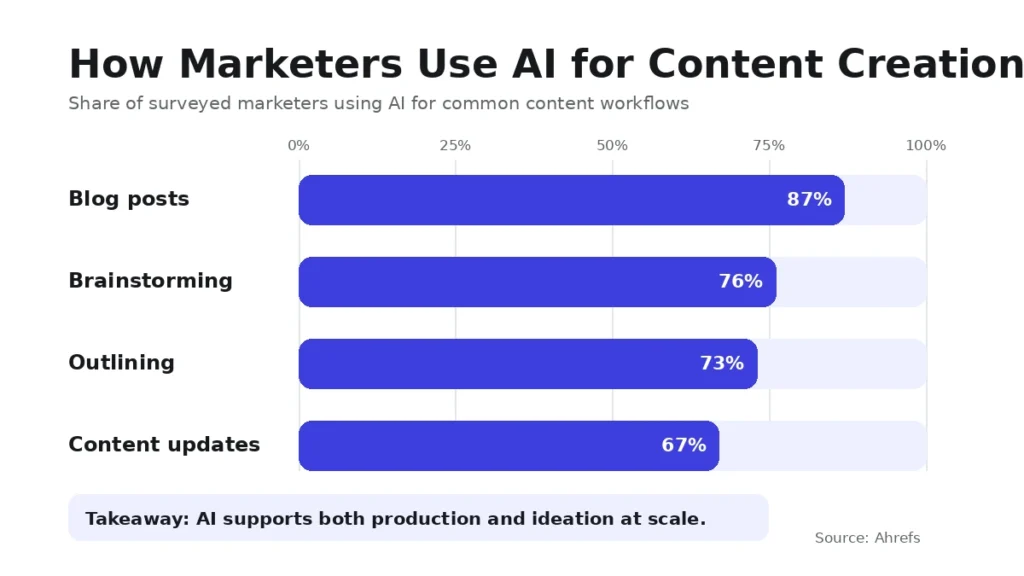
- 87% use AI for blog-post content, making blogs the most common AI-generated content type in the survey. (Ahrefs AI Content)
- 76% use AI for brainstorming. (Ahrefs AI Content)
- 73% use AI for outlining. (Ahrefs AI Content)
- 67% use AI for content updates or improvement. (Ahrefs AI Content)
- ChatGPT is the most-used content-creation model in the Ahrefs survey at 44%. (Ahrefs AI Content)
- Gemini is used by 15% of respondents for content creation. (Ahrefs AI Content)
- Claude is used by 10% of respondents for content creation. (Ahrefs AI Content)
- Respondents named 94 distinct AI tools in Ahrefs’ survey. (Ahrefs AI Content)
- 74.2% of 900,000 newly detected English-language webpages analyzed by Ahrefs contained AI-generated content. (Ahrefs New Pages)
- 86.5% of top-20 ranking pages in Ahrefs’ research contain at least some AI-generated content. (Ahrefs AI SEO)
- 91.4% of pages cited in AI Overviews in Ahrefs’ research contain at least some AI-generated content. (Ahrefs AI SEO)
- Ahrefs found no correlation between the percentage of AI content and organic ranking position. (Ahrefs AI SEO)
- Ahrefs found no correlation between AI-content percentage and citation order in AI Overviews. (Ahrefs AI SEO)
- Websites using AI content grew 5% faster than sites not using AI in Ahrefs’ survey-linked research. (Ahrefs AI SEO)
- 51% of companies in Ahrefs’ research planned to increase spending on AI-generated content. (Ahrefs AI SEO)
| Benchmark | Figure |
| 879 marketers surveyed by Ahrefs use AI to help create content | 87% |
| Marketers using AI published a median 17 articles per month | 17 articles |
| Marketers not using AI published a median 12 articles per month | 12 articles |
| AI users therefore published 42% more content per month | 42% |
Taken together, these content marketing seo statistics are best used as directional benchmarks. Sample design, geography, company size, and survey wording vary by source, so figures should not be averaged unless the underlying methods match.
Blogging benchmarks: content marketing seo statistics
The following content marketing seo statistics cover blogging benchmarks using the newest comparable figures available from the selected research set.
- Orbit Media’s 2026 survey covers 1,042 content marketers. (Orbit)
- The average blog post in Orbit Media’s 2026 survey is 1,312 words. (Orbit)
- The average time to create a blog post is 3 hours and 20 minutes. (Orbit)
- 13.9% of respondents say their blogs deliver strong marketing results. (Orbit)
- 18.9% say they do not know whether their blogs deliver results. (Orbit)
- 92.4% of respondents use AI for blogging. (Orbit)
- Average blog length fell from a 1,427-word peak in 2023 to 1,312 words in 2026. (Orbit)
- Average creation time fell from 4 hours 10 minutes in 2022 to 3 hours 20 minutes in 2026. (Orbit)
- Orbit Media says the historical strong-results rate had generally stayed between 20% and 30% before falling to 13.9% in 2026. (Orbit)
- Typeface reports that the share of marketers not using AI for blog creation fell from 65% to 5% over two years. (Typeface)
| Benchmark | Figure |
| Orbit Media’s 2026 survey covers 1,042 content marketers | 2026 |
| The average blog post | 2026 |
| The average time to create a blog post is 3 hours and 20 minutes | 3 hours and 20 minutes |
| respondents say their blogs deliver strong marketing results | 13.9% |
Taken together, these content marketing seo statistics are best used as directional benchmarks. Sample design, geography, company size, and survey wording vary by source, so figures should not be averaged unless the underlying methods match.
B2B strategy and content operations: content marketing SEO statistics
The following content marketing seo statistics cover b2b strategy and content operations using the newest comparable figures available from the selected research set.
- 95% of B2B marketers in CMI’s research have a content strategy. (CMI)
- 29% of B2B marketers with a content strategy rate it extremely or very effective. (CMI)
- 58% rate their content strategy moderately effective. (CMI)
- 12% rate it not very effective. (CMI)
- 1% rate it not at all effective. (CMI)
- 42% of marketers rating strategy moderately effective or worse cite unclear goals. (CMI)
- 39% cite a strategy that is not tied to the customer journey. (CMI)
- 35% cite a strategy that is not data-driven. (CMI)
- 29% cite ineffective audience research. (CMI)
- 23% cite unrealistic expectations. (CMI)
- 20% cite emphasizing content quantity over quality. (CMI)
- 18% cite failure to iterate or adapt. (CMI)
- 17% cite inconsistent brand voice. (CMI)
- 10% cite poor content quality. (CMI)
- 40% of B2B marketers cite creating the right content for the audience as a challenge. (CMI)
- 43% cite differentiating content as a challenge. (CMI)
- 42% cite creating content consistently as a challenge. (CMI)
- 39% cite creating enough content as a challenge. (CMI)
- 37% cite content repurposing as a challenge. (CMI)
- 35% cite optimizing for SEO as a challenge, down from 45% the prior year. (CMI)
- 27% cite creating quality content as a challenge, down from 44% the prior year. (CMI)
| Benchmark | Figure |
| B2B marketers | 95% |
| B2B marketers with a content strategy rate it extremely or very effective | 29% |
| rate their content strategy moderately effective | 58% |
| rate it not very effective | 12% |
Taken together, these content marketing seo statistics are best used as directional benchmarks. Sample design, geography, company size, and survey wording vary by source, so figures should not be averaged unless the underlying methods match.
What the content marketing seo statistics mean for 2026
The evidence supports four practical conclusions. First, website, blog, and SEO remain important B2B channels for usage and reported ROI. Second, AI-assisted production is already mainstream, but review and editing remain common.
Third, AI-search visibility does not perfectly mirror Google rankings, a shift also documented by The Verge, which means citation monitoring adds information that rank tracking alone misses. Fourth, measurement is a persistent constraint: marketers are producing more content while leaders continue to cite ROI attribution as a major challenge.
For teams using content marketing seo statistics to set targets, the safest approach is to benchmark by funnel stage. Track search impressions and rankings for discoverability, AI citations for answer-engine visibility, engaged sessions and qualified leads for content quality, and pipeline or revenue for commercial impact.
Methodology and source quality
This article was researched against the three supplied competitor URLs and then expanded with current first-party or research-publisher sources. Search-result snippets were used for discovery, but selected figures were checked against the source pages themselves.
The main evidence base is HubSpot’s 2026 marketing research, Ahrefs’ 2025 AI/SEO studies, Orbit Media’s 2026 blogging survey, and Content Marketing Institute’s B2B benchmarks.
The content marketing seo statistics are intentionally not blended into a single industry average. A survey of marketers, a crawl of 900,000 webpages, and a traffic study of 3,000 sites measure different things. Where the studies overlap, the article preserves the source’s population and framing.
FAQ
What are the most important content marketing seo statistics for 2026?
HubSpot’s 40.6% SEO-adaptation figure, Ahrefs’ 87% AI-content adoption figure, and HubSpot’s B2B website/blog/SEO usage and ROI figures are useful high-level benchmarks because they cover search strategy, production, and business performance.
Is content marketing still useful for SEO?
Yes. Current content marketing seo statistics show website/blog/SEO as the most-used B2B channel in HubSpot’s 2026 channel data, while Ahrefs finds a relationship between stronger organic traffic and greater visibility in AI responses.
How is AI changing content marketing SEO?
AI affects both sides of the workflow. Marketers use it to brainstorm, outline, update, and produce content, while AI Overviews and assistants create new discovery surfaces that do not perfectly reproduce Google’s organic rankings.
How common is AI-assisted content?
Ahrefs found that 87% of surveyed marketers use AI to help create content, while its crawl study found AI-generated material in 74.2% of 900,000 newly detected English-language webpages.
Are blogs still worth investing in?
Blogging remains strategically relevant, but results are uneven. Orbit Media’s 2026 survey found a 13.9% strong-results rate, while HubSpot continues to show website/blog/SEO as an important B2B channel.
How should content marketing SEO ROI be measured?
Use a layered model: visibility metrics such as rankings and AI citations, engagement and qualified-lead metrics, conversion metrics, and finally pipeline or revenue. This reduces dependence on a single attribution signal.