SEO statistics by company show that organic search still supplies enormous traffic even as AI changes how people discover and evaluate information. In 2025, Semrush measured more than 1 trillion organic-search visits across 17 industries, while AI referrals remained only 0.14% of total web traffic in its dataset (Semrush, 2026).
For teams comparing SEO statistics by company, the main pattern is clear: search volume remains large, but click behavior, AI citations, local discovery, content production, and crawler activity are shifting quickly. This page covers traffic, company adoption, content performance, AI search, local SEO, technical crawling, and ROI benchmarks.
Quick answer: In 2025, organic search generated more than 1 trillion visits in Semrush’s dataset, while AI traffic accounted for 0.14% of total visits (Semrush, 2026).
Key Stats at a Glance
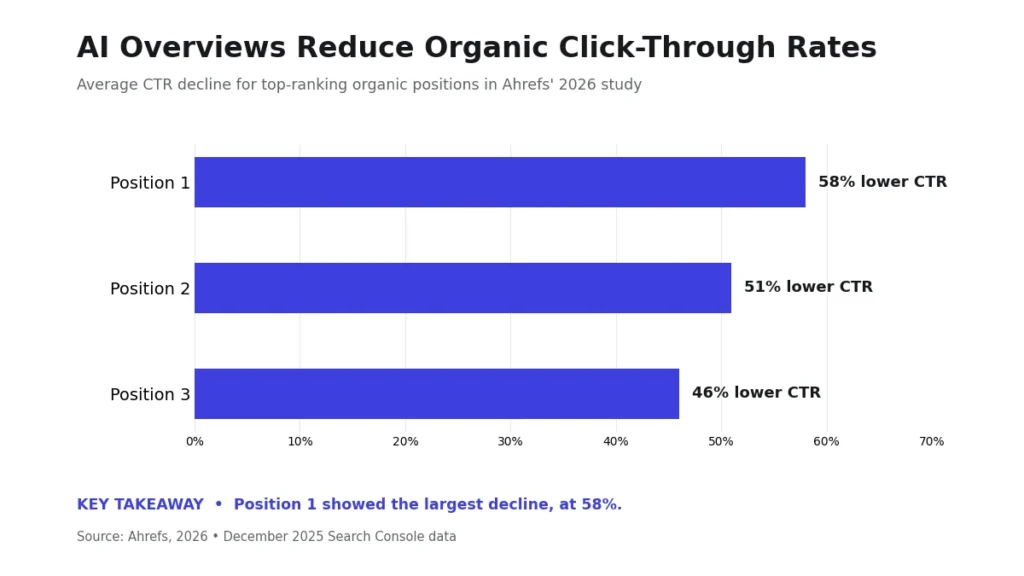
- AI Overviews: In December 2025 data, the top-ranking page had a 58% lower average CTR when an AI Overview appeared (Ahrefs, 2026).
- Organic traffic: Semrush recorded more than 1 trillion organic-search visits across 17 industries in 2025 (Semrush, 2026).
- Local search: 70% of general online searches in BrightLocal’s 2025 U.S. consumer study were conducted using Google (BrightLocal, 2025).
- AI referrals: 63% of the 3,000 websites in Ahrefs’ 2025 study received traffic from at least one AI chatbot (Ahrefs, 2025).
- Content teams: 76% of B2B marketers in 2024 fieldwork had a dedicated content marketing team or person (Content Marketing Institute, 2024).
SEO Statistics by Company: Search Demand and Traffic
Traffic data gives the broadest baseline. These SEO statistics by company compare organic search volume, channel share, industry movement, and consumer search behavior.
Semrush organic traffic and channel data
- In 2025, Semrush measured more than 1 trillion visits from organic search across 17 major industries. (Semrush, 2025)
- In 2025, organic search traffic across Semrush’s industry set grew 2.38% year over year. (Semrush, 2025)
- In 2025, organic search accounted for 16.04% of total web traffic in Semrush’s channel-mix dataset. (Semrush, 2025)
- In 2025, direct traffic accounted for 64.69% of total web traffic in the same Semrush dataset, a useful data point in seo statistics by company research. (Semrush, 2025)
- In 2025, organic search declined in 13 of the 17 industries Semrush analyzed. (Semrush, 2025)
- In 2025, apparel organic traffic grew 21.91%, the strongest gain among the growing industries in Semrush’s study. (Semrush, 2025)
- In 2025, beauty organic traffic grew 19.52% in Semrush’s industry data. (Semrush, 2025)
- In 2025, food organic traffic grew 0.91% in Semrush’s industry data. (Semrush, 2025)
- In 2025, retail organic traffic grew 0.52% in Semrush’s industry data. (Semrush, 2025)
- In 2025, healthcare organic traffic fell 30.09% in Semrush’s industry data. (Semrush, 2025)
- In 2025, banking organic traffic fell 27.09% in Semrush’s industry data. (Semrush, 2025)
- In 2025, education organic traffic fell 26.88% in Semrush’s industry data, a useful data point in seo statistics by company research. (Semrush, 2025)
- In 2025, wellness organic traffic fell 25.64% in Semrush’s industry data. (Semrush, 2025)
- In 2025, apparel’s share of total traffic from organic search fell 13.42% even though its organic visit volume grew. (Semrush, 2025)
- In 2025, beauty’s share of total traffic from organic search fell 15.23% even though its organic visit volume grew. (Semrush, 2025)
BrightLocal consumer search behavior
- In 2025, BrightLocal found that 70% of general online searches in its U.S. consumer study were conducted using Google. (BrightLocal, 2025)
- In 2025, nearly 3 in 5 U.S. consumers in BrightLocal’s study said they searched online multiple times per day. (BrightLocal, 2025)
- In 2025, almost one-quarter of BrightLocal respondents estimated that 41% to 60% of their searches had local intent. (BrightLocal, 2025)
- In 2025, 20% of BrightLocal respondents said they conducted local searches directly within map products, a useful data point in seo statistics by company research. (BrightLocal, 2025)
- In 2025, 30% of BrightLocal respondents said they were comfortable choosing one business from their research and making a decision. (BrightLocal, 2025)
SEO Statistics by Company: Organic Traffic Movement by Selected Industry
| Metric | 2025 result | Source |
| Apparel organic traffic | +21.91% | Semrush |
| Beauty organic traffic | +19.52% | Semrush |
| Healthcare organic traffic | −30.09% | Semrush |
| Banking organic traffic | −27.09% | Semrush |
| Education organic traffic | −26.88% | Semrush |
Source: Semrush, 2026.
The implication is that traffic volume alone is no longer a complete health check. SEO statistics by company should be read beside channel share and industry movement so a team can tell whether a change is company-specific or market-wide.
Company SEO Adoption, Content Teams and Budgets
Company adoption data shows how teams staff, measure, and fund search-related content. SEO statistics by company are most useful here as operating benchmarks rather than universal targets.
Team structure
- In 2024 fieldwork published for 2025, 76% of B2B marketers said their organization had a dedicated content marketing team or person. (Content Marketing Institute, 2025)
- In 2024 fieldwork, 54% of B2B marketers with dedicated content staff said the team had two to five people. (Content Marketing Institute, 2024)
- In 2024 fieldwork, 24% of B2B marketers said they had no dedicated content marketing team or person. (Content Marketing Institute, 2024)
- In 2024 fieldwork, 50% of B2B marketers without dedicated content staff said multiple internal content teams handled the work. (Content Marketing Institute, 2024)
- In 2024 fieldwork, 7% of B2B marketers without dedicated content staff said an outside agency or vendor handled the work, a useful data point in seo statistics by company research. (Content Marketing Institute, 2024)
Content-creation challenges
- In 2024 fieldwork, 35% of B2B marketers named SEO optimization as a top content-creation challenge, down from 45% in the prior survey. (Content Marketing Institute, 2024)
- In 2024 fieldwork, 40% of B2B marketers said creating the right content for the audience was a challenge, down from 57% in the prior survey. (Content Marketing Institute, 2024)
- In 2024 fieldwork, 43% of B2B marketers cited content differentiation as a challenge, down from 54% in the prior survey. (Content Marketing Institute, 2024)
- In 2024 fieldwork, 42% of B2B marketers cited consistent content creation as a challenge, down from 54% in the prior survey. (Content Marketing Institute, 2024)
- In 2024 fieldwork, 39% of B2B marketers said producing enough content was a challenge. (Content Marketing Institute, 2024)
- In 2024 fieldwork, 37% of B2B marketers said content repurposing was a challenge. (Content Marketing Institute, 2024)
Measurement
- In 2024 fieldwork, 96% of B2B marketers said they measured content performance. (Content Marketing Institute, 2024)
- In 2024 fieldwork, 51% of B2B marketers agreed that their organization measured content performance effectively. (Content Marketing Institute, 2024)
- In 2024 fieldwork, 56% of B2B marketers cited difficulty attributing ROI to content efforts, a useful data point in seo statistics by company research. (Content Marketing Institute, 2024)
- In 2024 fieldwork, 56% of B2B marketers cited difficulty tracking customer journeys. (Content Marketing Institute, 2024)
- In 2024 fieldwork, 44% of B2B marketers said tying performance to business goals was a measurement challenge. (Content Marketing Institute, 2024)
- In 2024 fieldwork, 41% of B2B marketers cited insufficient resources or budget as a measurement challenge. (Content Marketing Institute, 2024)
- In 2024 fieldwork, 39% of B2B marketers cited a lack of clear marketing goals or KPIs as a measurement challenge. (Content Marketing Institute, 2024)
Budgets
- For 2025 planning, 46% of B2B marketers who knew their budgets expected content marketing budgets to increase versus 2024. (Content Marketing Institute, 2025)
- For 2025 planning, 41% of those B2B marketers expected content marketing budgets to stay flat. (Content Marketing Institute, 2025)
SEO Statistics by Company: B2B Measurement and Budget Benchmarks
| Benchmark | 2024 fieldwork | Source |
| Measures content performance | 96% | CMI |
| Measures content effectively | 51% | CMI |
| Difficulty attributing ROI | 56% | CMI |
| Budget expected to rise in 2025 | 46% | CMI |
Source: Content Marketing Institute, 2024 fieldwork published for 2025.
The operating constraint is measurement, not just publishing capacity. SEO statistics by company can help teams compare staffing and budget choices, but each company still needs its own revenue and lead attribution.
Content and Ranking Statistics from SEO Companies
Ranking research now has to separate production method from finished quality. The SEO statistics by company below compare human-led workflows, AI-heavy pages, and content formats.
Semrush findings
- In 2026, Semrush found that 87% of surveyed SEO teams used either fully human-created content or human-led content workflows. (Semrush, 2026)
- In 2026, 64% of surveyed SEO professionals said a human-led, AI-assisted workflow was their most common production model, a useful data point in seo statistics by company research. (Semrush, 2026)
- In 2026, 23% of surveyed SEO professionals said they created content without AI. (Semrush, 2026)
- In 2026, 72% of surveyed SEO professionals said AI content ranked at least as well as human-written content. (Semrush, 2026)
- In Semrush’s 2025 ranking dataset, fully AI-generated content held position one only 9% of the time. (Semrush, 2025)
- In Semrush’s 2025 ranking dataset, human-written content held position one 80% of the time. (Semrush, 2025)
- In 2026, Semrush reported that position-one results were 8 times more likely to be human-written than fully AI-generated in its sample. (Semrush, 2026)
- In 2026, 70% of surveyed SEO professionals named speed as the top benefit of using AI for content. (Semrush, 2026)
- In 2026, only 19% of surveyed SEO professionals said AI improved content quality. (Semrush, 2026)
- In 2026, Semrush’s ranking analysis covered 20,000 keywords. (Semrush, 2026)
- In 2026, Semrush’s ranking analysis evaluated 42,000 blog pages, a useful data point in seo statistics by company research. (Semrush, 2026)
- In 2026, Semrush’s survey covered 224 SEO and content marketing professionals. (Semrush, 2026)
- In 2026, 58% of Semrush survey respondents said they directly created and optimized content. (Semrush, 2026)
- In 2026, 40% of Semrush survey respondents said they oversaw or approved content created by others. (Semrush, 2026)
Ahrefs findings
- In 2026, Ahrefs found that 5.3% of pages ranking in positions 1 to 3 were classified as 100% AI-generated. (Ahrefs, 2026)
- In 2026, Ahrefs found that 9% of pages ranking in positions 1 to 3 contained at least 80% AI content. (Ahrefs, 2026)
- In June 2026, Ahrefs analyzed 1 million pages drawn from the top 10 results of 100,000 SERPs for its AI-content ranking study. (Ahrefs, 2026)
- In 2026, Ahrefs reported a 49.28% indexation rate for pages in its low-AI-content bucket. (Ahrefs, 2026)
Content formats
- In 2024 fieldwork, 92% of B2B marketers used short articles or posts. (Content Marketing Institute, 2024)
- In 2024 fieldwork, 69% of B2B marketers used long articles or posts, a useful data point in seo statistics by company research. (Content Marketing Institute, 2024)
SEO Statistics by Company: AI Content Ranking Comparison
| Study | Figure | Scope | Date |
| Semrush | 9% | Fully AI content at position 1 | 2025 data |
| Ahrefs | 5.3% | 100% AI pages in positions 1–3 | June 2026 |
| Semrush | 80% | Human-written content at position 1 | 2025 data |
Source: Semrush, 2026; Ahrefs, 2026.
The two AI-content studies produce a 5.3% to 9% range because they use different ranking scopes and classifiers. SEO statistics by company are more useful when the method is kept beside the figure instead of treating different samples as interchangeable.
AI Search and Citation Statistics by Company
AI search is changing SERP composition and click behavior. These SEO statistics by company track AI Overview frequency, intent mix, ad overlap, citations, and CTR.
AI Overview prevalence (Semrush)
- In January 2025, AI Overviews appeared for 6.49% of the keywords Semrush tracked. (Semrush, 2025)
- In July 2025, AI Overviews appeared for 24.61% of the keywords Semrush tracked. (Semrush, 2025)
- In November 2025, AI Overviews appeared for 15.69% of the keywords Semrush tracked. (Semrush, 2025)
- From January to July 2025, Semrush measured an 18.12 percentage-point increase in AI Overview prevalence. (Semrush, 2025)
- From July to November 2025, Semrush measured an 8.92 percentage-point decline in AI Overview prevalence. (Semrush, 2025)
Query intent mix (Semrush)
- In January 2025, 91.3% of queries triggering AI Overviews in Semrush’s data were informational. (Semrush, 2025)
- By October 2025, the informational share of AI Overview queries in Semrush’s data had fallen to 57.1%. (Semrush, 2025)
- From October 2024 to October 2025, the commercial share of AI Overview queries rose from 8.15% to 18.57%, a useful data point in seo statistics by company research. (Semrush, 2025)
- From October 2024 to October 2025, the transactional share of AI Overview queries rose from 1.98% to 13.94%. (Semrush, 2025)
- From October 2024 to October 2025, the navigational share of AI Overview queries rose from 0.84% to 10.33%. (Semrush, 2025)
- In 2025, nearly 60% of keywords triggering AI Overviews had 100 or fewer monthly searches in Semrush’s study. (Semrush, 2025)
- In 2025, nearly 60% of keywords triggering AI Overviews fell in Semrush’s 21 to 60 Keyword Difficulty range. (Semrush, 2025)
SERP features and ads (Semrush)
- In late 2025, Related Searches appeared alongside AI Overviews on 95.32% of the SERPs Semrush examined. (Semrush, 2025)
- In late 2025, People Also Ask appeared alongside AI Overviews on 90.03% of the SERPs Semrush examined. (Semrush, 2025)
- In late 2025, Google Ads appeared at the bottom on 25% of AI Overview SERPs in Semrush’s analysis. (Semrush, 2025)
- From March to October 2025, the share of AI Overview SERPs with Google Ads rose from 5.17% to 25.56%, a 394% increase reported by Semrush. (Semrush, 2025)
Industry and domain data (Semrush)
- In 2025, Semrush found that Science had AI Overviews on 25.96% of tracked keywords in November, a useful data point in seo statistics by company research. (Semrush, 2025)
- In 2025, Semrush found that Computers and Electronics had AI Overviews on 17.92% of tracked keywords in November. (Semrush, 2025)
- In 2025, Semrush found that People and Society had AI Overviews on 17.29% of tracked keywords in November. (Semrush, 2025)
- From Q1 to Q4 2025, Semrush measured a 155% average increase in AI Overview keyword presence across the top 1,000 domains in each industry. (Semrush, 2025)
CTR impact (Ahrefs)
- In December 2025 data published in 2026, Ahrefs found AI Overviews correlated with a 58% lower average CTR for the top-ranking page. (Ahrefs, 2026)
- In 2026, Ahrefs’ updated CTR study used 300,000 keywords, split into 150,000 AI Overview keywords and 150,000 informational keywords without AI Overviews. (Ahrefs, 2026)
AI Overviews vs. AI Mode (Ahrefs)
- In September 2025 data, Ahrefs found only 13.7% citation overlap between AI Overviews and AI Mode. (Ahrefs, 2025)
- In September 2025 data, Ahrefs found only 16% word-level overlap between AI Overviews and AI Mode. (Ahrefs, 2025)
- In September 2025 data, AI Overviews and AI Mode began with the same first sentence only 2.51% of the time, a useful data point in seo statistics by company research. (Ahrefs, 2025)
- In September 2025 data, Ahrefs found AI Mode and AI Overviews agreed semantically about 9 times out of 10. (Ahrefs, 2025)
- In September 2025 data, AI Mode responses contained 2.5 times more people and brand entities than AI Overviews. (Ahrefs, 2025)
- In September 2025 data, a brand mentioned in an AI Overview had a 61% chance of also appearing in the paired AI Mode response. (Ahrefs, 2025)
- In September 2025 data, 32.8% of paired AI responses in Ahrefs’ study contained no person or brand entity. (Ahrefs, 2025)
- In September 2025 data, AI Mode returned no citations in 3% of responses, while AI Overviews returned no citations in 11%. (Ahrefs, 2025)
SEO Statistics by Company: AI Overview Trend and Source Comparison
| Source | Figure | Date | Scope or method note |
| Semrush | 15.69% | Nov. 2025 | Share of tracked keywords with AI Overviews |
| Ahrefs | −58% CTR | Dec. 2025 | CTR difference for position 1 with AI Overviews |
Source: Semrush, 2025; Ahrefs, 2026; Google, 2025.
AI Overview prevalence and CTR impact measure different parts of the search experience. SEO statistics by company should separate visibility, clicks, and usage so teams do not treat one metric as a substitute for another.
ChatGPT, AI Referral and Freshness Benchmarks
Referral and citation data helps explain what happens after an AI system retrieves a page. SEO statistics by company in this section focus on ChatGPT, freshness, and AI traffic.
ChatGPT citation behavior (Ahrefs, 2026)
- In 2026, Ahrefs found ChatGPT cited roughly 50% of the URLs it retrieved across 1.4 million prompts. (Ahrefs, 2026)
- In 2026, Ahrefs found that 88.46% of URLs in ChatGPT’s general search retrieval type were cited. (Ahrefs, 2026)
- In 2026, Ahrefs found a 12.01% citation rate for URLs in ChatGPT’s news retrieval type. (Ahrefs, 2026)
- In 2026, Ahrefs found a 1.93% citation rate for URLs in ChatGPT’s Reddit retrieval type, a useful data point in seo statistics by company research. (Ahrefs, 2026)
- In 2026, Ahrefs found a 0.51% citation rate for URLs in ChatGPT’s YouTube retrieval type. (Ahrefs, 2026)
- In 2026, Ahrefs found a 0.40% citation rate for URLs in ChatGPT’s academia retrieval type. (Ahrefs, 2026)
- In 2026, ChatGPT pulled an average of 16.57 cited URLs per prompt in Ahrefs’ dataset. (Ahrefs, 2026)
- In 2026, ChatGPT pulled an average of 16.58 non-cited URLs per prompt in Ahrefs’ dataset. (Ahrefs, 2026)
- In 2026, Reddit made up 67.8% of the non-cited URL pool in Ahrefs’ ChatGPT retrieval dataset. (Ahrefs, 2026)
- In 2026, the semantic similarity score between a prompt and a cited URL title was 0.602 in Ahrefs’ analysis. (Ahrefs, 2026)
- In 2026, the semantic similarity score between a prompt and a non-cited URL title was 0.484 in Ahrefs’ analysis. (Ahrefs, 2026)
- In 2026, the maximum semantic similarity score between fan-out queries and cited URL titles was 0.656 in Ahrefs’ analysis. (Ahrefs, 2026)
Freshness
- In 2026, the median cited page in Ahrefs’ ChatGPT search-index sample was about 500 days old, a useful data point in seo statistics by company research. (Ahrefs, 2026)
- In 2025 research, Ahrefs found AI assistants cited content that was 25.7% fresher on average than pages ranking in organic Google results. (Ahrefs, 2025)
- In 2025 research, Ahrefs analyzed 16.975 million cited URLs across AI assistants and Google results. (Ahrefs, 2025)
AI referral traffic
- In 2025, 63% of the 3,000 websites in an Ahrefs study received referral traffic from at least one of seven AI chatbots. (Ahrefs, 2025)
- In 2025, three chatbots generated 98% of the AI referral traffic measured by Ahrefs. (Ahrefs, 2025)
- In 2025, ChatGPT generated 50% of AI referral traffic in Ahrefs’ 3,000-site study. (Ahrefs, 2025)
- In 2025, Ahrefs found attributable AI traffic represented roughly 0.1% of traffic for sites with more than 1 million visits. (Ahrefs, 2025)
- In 2025, URL paths containing ‘best’ appeared on 7.06% of domains receiving AI traffic in Ahrefs’ page-type analysis. (Ahrefs, 2025)
- In 2025, URL paths containing ‘top’ appeared on 5.5% of domains receiving AI traffic in Ahrefs’ page-type analysis. (Ahrefs, 2025)
- In 2025, URL paths containing ‘vs’ appeared on 4.88% of domains receiving AI traffic in Ahrefs’ page-type analysis, a useful data point in seo statistics by company research. (Ahrefs, 2025)
- In 2025, Semrush measured AI referral traffic growth of 66.02% across its industry dataset. (Semrush, 2025)
- In 2025, Semrush measured AI traffic rising from 462 million to 767 million monthly visits. (Semrush, 2025)
- In 2025, AI referral traffic accounted for 0.14% of total web traffic in Semrush’s dataset. (Semrush, 2025)
SEO Statistics by Company: AI Referral and Citation Benchmarks
| Source | Figure | Date | Scope or method note |
| Ahrefs | ~0.1% | 2025 | AI traffic share for sites above 1M visits |
| Semrush | 0.14% | 2025 | AI traffic share across 17 industries |
| Ahrefs | 63% | 2025 | Sites receiving any AI referral traffic |
Source: Ahrefs, 2025; Semrush, 2026.
Ahrefs and Semrush place attributable AI traffic at roughly 0.1% to 0.14% in different samples. SEO statistics by company show fast growth from a small base, which makes referral volume and citation visibility separate metrics to track.
Local SEO Statistics by Company
Local discovery now spans Google, maps, reviews, social platforms, and AI tools. These SEO statistics by company show how consumers research nearby businesses.
Consumer behavior
- In 2025, 85% of BrightLocal respondents said contact information and opening hours were important when researching local businesses. (BrightLocal, 2025)
- In 2025, 40% of BrightLocal respondents said they actively used generative AI within search. (BrightLocal, 2025)
- In 2025, 25% of Gen Z consumers in BrightLocal’s study used social media as their primary method for local search. (BrightLocal, 2025)
- In 2025, one in five BrightLocal respondents used map products directly for local searches, a useful benchmark for location-focused SEO. (BrightLocal, 2025)
Reviews and study panels
- In 2025, BrightLocal’s consumer search study used a representative panel of 1,000 U.S. adults. (BrightLocal, 2025)
- In 2025, BrightLocal’s Local Consumer Review Survey used a representative panel of 1,026 U.S. adults. (BrightLocal, 2025)
- In 2025, BrightLocal reported that consumers were more willing than in prior years to accept lower total review counts when evaluating local businesses, a useful data point in seo statistics by company research. (BrightLocal, 2025)
- In 2025, BrightLocal reported that consumers were more lenient about review recency than in prior survey waves. (BrightLocal, 2025)
- In 2025, BrightLocal found consumers used multiple review sites and supporting video content to verify local-business choices. (BrightLocal, 2025)
- In 2025, BrightLocal found consumers were willing to write about both positive and negative local-business experiences. (BrightLocal, 2025)
- In 2025, 21% of BrightLocal’s local review survey panel was age 18 to 29. (BrightLocal, 2025)
- In 2025, 26% of BrightLocal’s local review survey panel was age 30 to 44. (BrightLocal, 2025)
- In 2025, 28% of BrightLocal’s local review survey panel was age 45 to 60. (BrightLocal, 2025)
- In 2025, 26% of BrightLocal’s local review survey panel was older than 60. (BrightLocal, 2025)
AI in local search
- In early 2025, only 3% of BrightLocal respondents said an AI platform was their default tool for local searches. (BrightLocal, 2025)
- In 2025, 6% of consumers in BrightLocal’s earlier measurement used AI to find local-business recommendations, a useful data point in seo statistics by company research. (BrightLocal, 2025)
- In 2026, BrightLocal reported that 45% of consumers used AI to find local-business recommendations. (BrightLocal, 2026)
- From 2025 to 2026, BrightLocal’s measured use of AI for local-business recommendations rose by 39 percentage points. (BrightLocal, 2026)
- From 2025 to 2026, BrightLocal’s measured use of AI for local-business recommendations grew 7.5 times, from 6% to 45%. (BrightLocal, 2026)
- In 2026, BrightLocal described AI as the third most-used tool for local-business recommendations, behind Google and Facebook. (BrightLocal, 2026)
SEO Statistics by Company: Local Search and AI Adoption
| Local-search measure | Figure | Year | Source |
| General searches conducted on Google | 70% | 2025 | BrightLocal |
| Active use of generative AI in search | 40% | 2025 | BrightLocal |
| AI used for local recommendations | 45% | 2026 | BrightLocal |
| Local searches conducted in maps | 20% | 2025 | BrightLocal |
Source: BrightLocal, 2025; BrightLocal, 2026.
Local search is becoming more multi-platform, especially as AI use rises. SEO statistics by company suggest that local teams need consistent business information and review coverage across the places consumers actually check.
Technical SEO, Crawling and Site Infrastructure
Crawler activity affects indexing, server load, and AI access. The SEO statistics by company below use Cloudflare’s network data to show how search and AI bots behave at scale.
Network scale
- In 2025, Cloudflare’s network handled more than 81 million HTTP requests per second on average. (Cloudflare, 2025)
- In 2025, Cloudflare recorded peaks above 129 million HTTP requests per second. (Cloudflare, 2025)
- In 2025, Cloudflare handled roughly 67 million authoritative and resolver DNS queries per second. (Cloudflare, 2025)
- In 2025, global internet traffic observed by Cloudflare grew 19%, a useful data point in seo statistics by company research. (Cloudflare, 2025)
Verified bot traffic
- In 2025, Googlebot generated more than 28% of Cloudflare’s Verified Bot traffic. (Cloudflare, 2025)
- In 2025, GPTBot generated about 7.5% of Cloudflare’s Verified Bot traffic. (Cloudflare, 2025)
- In 2025, Bingbot generated 6% of Cloudflare’s Verified Bot traffic. (Cloudflare, 2025)
- In 2025, search-engine crawlers generated 40% of Cloudflare’s Verified Bot traffic. (Cloudflare, 2025)
- In 2025, AI crawlers generated 20% of Cloudflare’s Verified Bot traffic. (Cloudflare, 2025)
- In 2025, SEO bots generated more than 13% of Cloudflare’s Verified Bot requests. (Cloudflare, 2025)
HTML request share
- In 2025, AI bots other than Googlebot accounted for an average 4.2% of HTML requests on Cloudflare. (Cloudflare, 2025)
- In 2025, Googlebot alone accounted for 4.5% of HTML requests on Cloudflare. (Cloudflare, 2025)
- In late June 2025, AI bots reached a 6.4% share of HTML requests on Cloudflare, a useful data point in seo statistics by company research. (Cloudflare, 2025)
- In early April 2025, AI bots fell to a 2.4% share of HTML requests on Cloudflare. (Cloudflare, 2025)
- In late April 2025, Googlebot peaked at an 11% share of HTML requests on Cloudflare. (Cloudflare, 2025)
- By December 2, 2025, human traffic generated 47% of Cloudflare HTML requests. (Cloudflare, 2025)
- By December 2, 2025, non-AI bots generated 44% of Cloudflare HTML requests. (Cloudflare, 2025)
AI crawler growth
- In 2025, AI user-action crawling grew more than 21 times from January through early December on Cloudflare. (Cloudflare, 2025)
- In 2025, ChatGPT-User peak request volumes reached as much as 16 times their beginning-of-year level on Cloudflare. (Cloudflare, 2025)
- In 2025, OAI-SearchBot peak request volume reached about 5 times its beginning-of-year level during a late-October spike. (Cloudflare, 2025)
SEO Statistics by Company: Crawler Share Benchmarks
| Traffic type | Share | Year | Source |
| Search-engine crawlers | 40% of Verified Bot traffic | 2025 | Cloudflare |
| AI crawlers | 20% of Verified Bot traffic | 2025 | Cloudflare |
| Googlebot | >28% of Verified Bot traffic | 2025 | Cloudflare |
| SEO bots | >13% of Verified Bot requests | 2025 | Cloudflare |
Source: Cloudflare, 2025.
Search and AI crawlers now create material request volume on large web infrastructure. SEO statistics by company can guide crawl monitoring, but server logs remain the best company-specific record of what bots actually request.
SEO ROI, Channel Performance and Business Benchmarks
ROI data connects search activity with business planning. These SEO statistics by company compare channel expectations, content outcomes, and the marketing formats teams report as effective.
Clutch channel and social data (2026)
- In 2026, 24% of 337 marketing professionals surveyed by Clutch said email would deliver their highest ROI. (Clutch, 2026)
- In 2026, 20% of Clutch respondents said paid social would deliver their highest ROI, a useful data point in seo statistics by company research. (Clutch, 2026)
- In 2026, 20% of Clutch respondents said search would deliver their highest ROI. (Clutch, 2026)
- In 2026, 19% of Clutch respondents said organic social media would deliver their highest ROI. (Clutch, 2026)
- In 2026, Clutch’s ROI survey included 337 marketing professionals. (Clutch, 2026)
- In 2026, Clutch reported that 86% of marketers used Facebook in their social media strategies. (Clutch, 2026)
- In 2026, Clutch reported that 79% of marketers used Instagram in their social media strategies. (Clutch, 2026)
- In 2026, Clutch cited research showing 90% of vertical videos had higher watch-completion rates than horizontal videos. (Clutch, 2026)
- In 2026, Clutch cited research projecting 86% of U.S. marketing agencies would partner with influencers. (Clutch, 2026)
Content marketing outcomes (CMI, 2024 fieldwork)
- In 2024 fieldwork, 87% of B2B marketers said content marketing helped create brand awareness. (Content Marketing Institute, 2024)
- In 2024 fieldwork, 74% of B2B marketers said content marketing helped generate demand or leads, a useful data point in seo statistics by company research. (Content Marketing Institute, 2024)
- In 2024 fieldwork, 62% of B2B marketers said content marketing helped nurture subscribers, audiences or leads. (Content Marketing Institute, 2024)
- In 2024 fieldwork, 52% of B2B marketers said content marketing helped grow loyalty among existing customers. (Content Marketing Institute, 2024)
- In 2024 fieldwork, 49% of B2B marketers said content marketing helped generate sales or revenue. (Content Marketing Institute, 2024)
- In 2024 fieldwork, 37% of B2B marketers said content marketing helped grow a subscribed audience. (Content Marketing Institute, 2024)
Self-rated success and best-performing formats (CMI, 2024 fieldwork)
- In 2024 fieldwork, 22% of B2B marketers rated their content marketing as extremely or very successful. (Content Marketing Institute, 2024)
- In 2024 fieldwork, 54% of B2B marketers rated their content marketing as moderately successful. (Content Marketing Institute, 2024)
- In 2024 fieldwork, 21% of B2B marketers rated their content marketing as minimally successful or not successful. (Content Marketing Institute, 2024)
- In 2024 fieldwork, 58% of B2B marketers rated video as one of the content types producing the best results. (Content Marketing Institute, 2024)
- In 2024 fieldwork, 53% of B2B marketers rated case studies and customer stories among the content types producing the best results. (Content Marketing Institute, 2024)
SEO Statistics by Company: Reported Channel ROI Expectations
| Channel | Marketers expecting highest ROI | Year | Source |
| 24% | 2026 | Clutch | |
| Paid social | 20% | 2026 | Clutch |
| Search | 20% | 2026 | Clutch |
| Organic social | 19% | 2026 | Clutch |
Source: Clutch, 2026.
Search remains tied with paid social in Clutch’s 2026 highest-ROI expectations. SEO statistics by company work best as planning inputs, then teams can validate the channel against their own pipeline and revenue data.
How These Statistics Were Compiled
This SEO statistics by company roundup uses first-party studies, company research pages, and official product or infrastructure releases. The date window is 2024 through September 2026, with no older figures used. Research was checked against the latest accessible version of each source on September 18, 2026. Where two credible sources measured similar topics differently, the figures are shown as a range or side-by-side comparison rather than averaged. SEO statistics by company can vary because samples, query sets, traffic panels, geographies, and definitions differ, so the method and date stay attached to each benchmark.
Conclusion
SEO statistics by company point to three patterns: organic search remains large, AI changes click and citation behavior, and local discovery is spreading across more platforms.
The next step is to track traffic, visibility, citations, and revenue separately, then compare each company metric with a like-for-like benchmark.
FAQ
What are the most useful SEO statistics by company to track?
SEO statistics by company are most useful when they connect visibility to business outcomes. In 2025, Semrush recorded more than 1 trillion organic-search visits across 17 industries, showing the channel’s scale (Semrush, 2026). Track organic visits, non-brand visibility, conversions, AI citations, local actions, and revenue with consistent definitions.
Is SEO still driving meaningful traffic in 2026?
Yes. SEO statistics by company still show organic search at very large scale. Semrush measured organic search at 16.04% of total web traffic in its 2025 cross-industry dataset (Semrush, 2026). The share varies by industry, so compare your company with a relevant sector benchmark rather than a web-wide average.
How much traffic comes from AI search?
Current SEO statistics by company put directly attributable AI referral traffic at a small share. Semrush measured AI referrals at 0.14% of total traffic in 2025 (Semrush, 2026). Ahrefs reported roughly 0.1% for sites above 1 million visits, showing a similar range in a different sample (Ahrefs, 2025).
Do AI Overviews reduce organic clicks?
The latest SEO statistics by company show a sizable association for informational queries. Ahrefs found that an AI Overview correlated with a 58% lower average CTR for the top-ranking page in December 2025 data (Ahrefs, 2026). The effect can differ by intent, query type, device, and market.
Does AI-generated content rank in Google?
It can rank, but the 2026 company studies show a human-content advantage in their samples. Semrush found fully AI-generated content at position one 9% of the time in its 2025 dataset (Semrush, 2026). Ahrefs separately found 5.3% of pages in positions 1 to 3 were classified as 100% AI-generated (Ahrefs, 2026).
How is local search changing?
SEO statistics by company show local discovery spreading beyond a single search box. BrightLocal found 40% of U.S. consumers actively used generative AI within search in 2025 (BrightLocal, 2025). By 2026, 45% reported using AI for local-business recommendations in BrightLocal’s newer research (BrightLocal, 2026).
What should companies benchmark for SEO ROI?
SEO statistics by company can set a reference point, but ROI needs company revenue data. In Clutch’s 2026 survey, 20% of 337 marketing professionals expected search to deliver their highest ROI (Clutch, 2026). Compare that expectation with your own customer acquisition cost, lead quality, conversion rate, and payback period.
How often should SEO statistics by company be refreshed?
Refresh SEO statistics by company at least annually, and update fast-moving AI-search figures more often. Semrush saw AI Overview prevalence move from 6.49% in January 2025 to 24.61% in July and 15.69% in November (Semrush, 2025). That volatility makes dated measurements much more useful than undated claims.